

The most common question in the GH-secretagogue space is not which compound is stronger. It is whether a research subject wants a clean pulsatile GH pulse delivered by injection or a sustained 24-hour elevation taken by mouth. The ipamorelin vs MK-677 decision is, at its core, a decision about pharmacokinetics, route, and what the GH-IGF-1 axis is actually being asked to do. This editorial walks through the head-to-head data, the dosing each compound was validated at, and the safety divergence that should drive the choice.
Key takeaways#
- Ipamorelin is an injectable pentapeptide; MK-677 (ibutamoren) is an orally bioavailable non-peptide small molecule. The oral vs injectable growth hormone secretagogue split is the single largest practical difference between them.
- Half-life is the second axis: ipamorelin clears in roughly 2 hours, MK-677 supports once-daily dosing with elevated GH and IGF-1 across the full 24-hour cycle. The mk-677 vs ipamorelin half life gap is what determines pulse architecture.
- MK-677 produced a 97% increase in 24-hour mean GH at 25 mg/day and pushed IGF-1 into the young-adult range over a one-year trial, but with measurable insulin-sensitivity decline and fasting-glucose rise.
- Ipamorelin side effects are notably mild because the molecule does not raise ACTH, cortisol, or prolactin meaningfully; MK-677 side effects skew toward appetite, edema, fasting glucose, and (in one trial) excess congestive heart failure events.
- Neither compound is approved by the FDA or EMA, and neither can be compounded in the US: ibutamoren is in FDA Category 2 for pharmacies and outsourcing facilities over a heart-failure signal, and ipamorelin is in Category 2 for outsourcing facilities and not on the 503A bulks list. Both are on the WADA prohibited list.
How ipamorelin works (and how it differs in dosage vs MK-677)#
Ipamorelin is a synthetic pentapeptide (Aib-His-D-2-Nal-D-Phe-Lys-NH2) developed at Novo Nordisk and first characterized by Raun et al. in 1998 as the first selective growth hormone secretagogue, meaning a GHRP-receptor agonist that releases GH without significant ACTH, cortisol, or prolactin elevation. Mechanistically it agonizes the GHS-R1a (ghrelin) receptor on anterior pituitary somatotrophs, triggering a calcium-mediated GH exocytosis event.
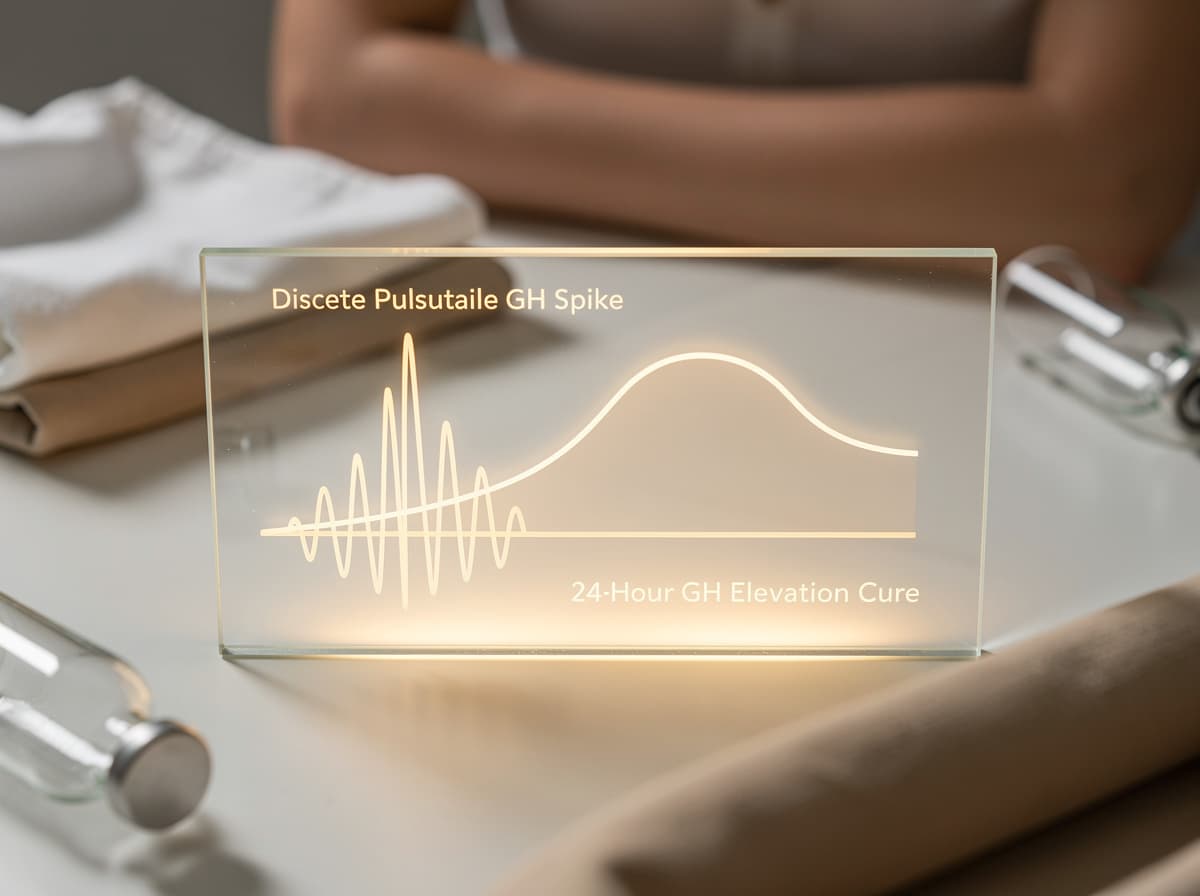
Pharmacokinetically it is a short-window compound. Published PK/PD modeling in human volunteers documented a discrete GH peak at approximately 0.67 hours post-administration with exponential decline to negligible GH concentration thereafter. Plasma half-life sits near 2 hours and the entire response cycle finishes within roughly 4 hours. Research suggests this pulsatile architecture is the mechanistic selling point: it mimics the discrete pulses of endogenous GH rather than producing tonic flooding of the somatotroph axis, and the practical consequence for ipamorelin dosage vs mk-677 protocols is that ipamorelin requires multiple daily injections to maintain elevation while MK-677 does not.
How MK-677 works#
MK-677 (ibutamoren, also known as MK-0677 or L-163,191) is not a peptide. It is a synthetic non-peptide small molecule with a spiroindane-piperidine scaffold, originally developed at Merck. It binds the same GHS-R1a receptor as ipamorelin and as endogenous ghrelin, but its oral bioavailability and long action profile come from the non-peptide structure. The compound is a first orally active ghrelin mimetic shown to increase pulsatile GH secretion in the elderly, which framed its entire clinical-development arc.
Pharmacokinetically it is the inverse of ipamorelin. Once-daily oral dosing produces sustained GH and IGF-1 elevation across the day rather than a discrete pulse. In the seminal Chapman et al. healthy-elderly trial, MK-677 25 mg/day for two weeks increased mean 24-hour GH concentration by 97 ± 23%, an effect driven by enhancement of preexisting pulsatile secretion (taller pulses, not more frequent ones) rather than tonic flooding. Research has shown that the pulsatile pattern of GH secretion at baseline is maintained and enhanced at 6 and 12 months, primarily because of increased secretion per peak rather than peak frequency, which matters because preserved pulsatility is mechanistically preferable to flat-line GH exposure.
Dosing, evidence, and how the two stack up head-to-head#
For ipamorelin, research protocols typically deliver the peptide subcutaneously in the 100-300 mcg range per administration, dosed one to three times daily, with timing often anchored to pre-sleep or fasted states to avoid postprandial somatostatin tone. The original PK work, using 15-minute intravenous infusions, documented GH peaks at approximately 40 minutes after dosing, which is why protocols cluster the dose around windows when an exogenous GH pulse is desired.
For MK-677, the clinically tested oral dose is 25 mg once daily. The Nass two-year trial in older adults used 25 mg/day at 7-9 a.m., while bodybuilding-adjacent literature has described 5-25 mg/day depending on phase. Bedtime dosing is common in non-clinical practice because peak drug exposure aligns with the body's nocturnal GH pulse, though some users report sleep disturbance at that timing. The dosing asymmetry is the headline of ipamorelin dosage vs mk-677: multiple subcutaneous injections versus a single oral capsule.
On the evidence ledger, MK-677 has substantially more long-duration human data. The Chapman 1996 trial established the 97% 24-hour GH increase and the dose-response curve in healthy elderly subjects, and a separate dose-ranging analysis demonstrated sustained pulsatile GH increases for as long as MK-677 was given for up to 2 years, with levels returning to baseline after the medication was stopped. Studies have shown the Nass 65-subject older-adult cohort produced a ~0.8 kg increase in body cell mass versus a 1.0 kg decrease in placebo, but with no improvement in strength or functional performance. Ipamorelin's human evidence base is smaller; the Gobburu PK/PD work and a 2014 Phase 2 RCT in postoperative ileus (well tolerated, but no significant benefit over placebo) remain the best-characterized trials, with most longer-duration data still drawn from preclinical rodent and swine models. Preliminary evidence on bone formation, longitudinal growth, and selectivity is strong but the human-trial volume is the weaker side of the comparison.
Ipamorelin side effects vs MK-677 side effects#
The two diverge sharply on safety, and this is where the comparison earns its weight.
Ipamorelin side effects are characterized primarily by what does not happen. Raun et al. demonstrated that ipamorelin did not release ACTH or cortisol in levels significantly different from those observed following GHRH stimulation, an effect maintained even at doses more than 200-fold higher than the ED50 for GH release. There is no meaningful prolactin elevation, no clinically relevant cortisol bump, and the most commonly reported issues are mild injection-site reactions, transient flushing, and occasional headache. Ipamorelin side effects are dose-dependent and generally resolve within hours given the short half-life. The injection requirement itself is the largest practical drawback.
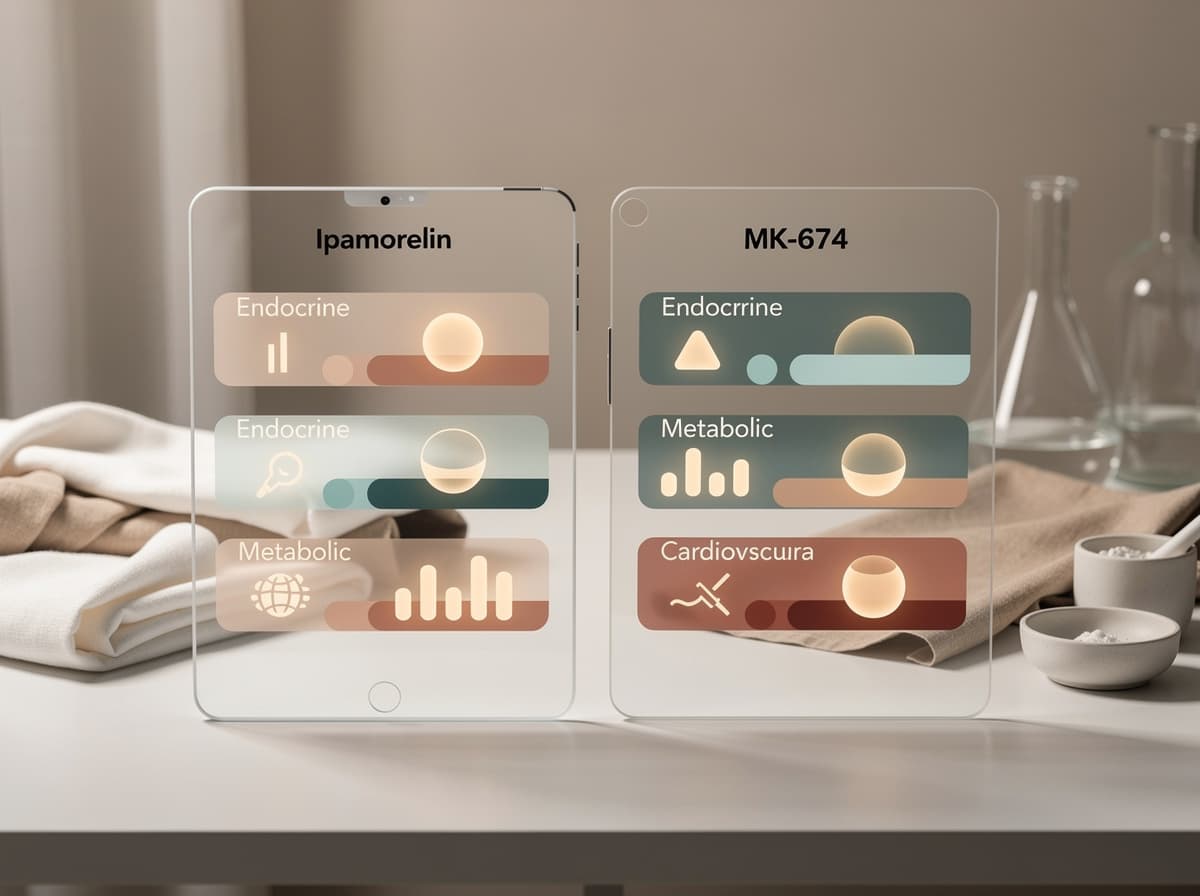
MK-677 side effects carry a heavier ledger. In the Nass trial, the most frequent issues were mild, transient lower-extremity edema, transient muscle pain, and increased appetite. More concerning: fasting blood glucose rose roughly 0.3 mmol/L (about 5 mg/dL), HbA1c rose 0.2%, and insulin sensitivity declined by the Quicki Index, as reported in the Oxford Gerontology review. A separate hip-fracture trial (Adunsky et al.) identified a higher congestive heart failure rate in the ibutamoren group versus placebo, leading to early termination. MK-677 side effects also commonly include marked appetite stimulation (a direct consequence of GHS-R1a agonism in hypothalamic feeding centres) and water retention. The FDA has also issued warnings about hidden ibutamoren in consumer products, and the compound is on the WADA prohibited list. For research subjects with metabolic-syndrome risk, family history of type 2 diabetes, or cardiovascular concerns, the MK-677 side effects profile is the disqualifier.
When to choose ipamorelin, when to choose MK-677, and whether to stack#
Choose ipamorelin when:
- The research goal is to mimic endogenous pulsatile GH secretion rather than produce sustained elevation.
- Baseline insulin sensitivity or fasting glucose is borderline, or family history of type 2 diabetes is present.
- Cortisol or prolactin neutrality is required (older athletic populations, sleep-quality protocols).
- Injection logistics are acceptable. The pulsatile architecture also pairs cleanly with GHRH analogs (CJC-1295), and Klarovel's peptide calculator handles the reconstitution math.
Choose MK-677 when:
- Oral administration is a hard requirement (needle aversion, travel constraints, simplicity).
- A sustained 24-hour IGF-1 elevation is the desired endpoint, not a discrete pulse.
- Sleep architecture and lean-mass preservation are primary outcomes (the strongest signals in the published data).
- Metabolic risk factors are absent and the research subject can baseline and monitor fasting glucose and HbA1c.
Can you stack them? Mechanistically both act on GHS-R1a, so combining them is mostly redundant; at 25 mg MK-677 the receptor is likely already heavily engaged. Research literature has occasionally described co-administration with a GHRH analog like CJC-1295 (which hits a different receptor), where the paired effect on GH output is supra-additive rather than redundant. Stacking ipamorelin with MK-677 directly is not standard practice because the receptor overlap means the combined response is unlikely to exceed what 25 mg MK-677 already produces, while doubling the side-effect surface.
Verdict: which one actually wins#
For most research contexts, MK-677 is the better starting point when the goal is sustained IGF-1 elevation and oral convenience, and ipamorelin is the better starting point when the goal is clean pulsatile GH release without metabolic side effects. The question "is mk-677 stronger than ipamorelin" misframes the comparison. Strength is the wrong axis. MK-677 produces larger 24-hour cumulative GH exposure because it elevates the axis continuously, and 25 mg/day increased mean 24-hour GH by 97% in the Chapman trial. Ipamorelin produces a higher peak GH concentration at the 40-minute mark post-injection but returns to baseline within three hours. If the metric is IGF-1 area under the curve over a week, MK-677 typically wins on the "is mk-677 stronger than ipamorelin" comparison. If the metric is peak pulse amplitude in a single window plus endocrine cleanliness, ipamorelin is competitive and safer.
The deciding factor in practice is the metabolic baseline. A research subject with HbA1c at 5.4%, normal fasting glucose, and a primary endpoint of lean-mass preservation will likely tolerate MK-677 well and benefit from the once-daily oral convenience. A subject with HbA1c at 5.7%, family history of insulin resistance, or a primary endpoint of clean pulsatile mimicry should pick ipamorelin even though the injection burden is higher. The oral vs injectable growth hormone secretagogue choice should follow the metabolic health profile, not the convenience. Klarovel's engine applies the same logic: it blocks MK-677 outright at an HbA1c of 5.7% or higher, a fasting glucose of 100 mg/dL or higher, or a fasting insulin of 12 µIU/mL or higher.
Run your numbers, then pick#
The ipamorelin vs MK-677 question collapses into a two-step decision: what does the metabolic health profile look like, and what is the research endpoint. For sustained IGF-1 elevation with oral convenience and a tolerable metabolic baseline, MK-677. For clean pulsatile GH release without endocrine collateral, ipamorelin. Quantify the inputs first using the peptide calculator, complete the intake questionnaire (adding recent labs if you have them) so the protocol matches the physiology, and review how Klarovel works before committing to either path. For the underlying biology that makes the pulsatile-versus-sustained choice matter, the GH axis explained lays out how the GH-IGF-1 system actually works.
Frequently asked questions
Keep reading
Peptides for Inflammation: Mapping BPC-157, KPV, and Thymosins
Peptides for inflammation compared by mechanism and evidence stage: BPC-157, KPV, thymosin alpha-1, and thymosin beta-4, with FDA status and safety notes.
Mounjaro vs Zepbound: Same Drug, Two Different FDA Labels
Mounjaro and Zepbound are the same drug, tirzepatide, at the same doses. The difference is the FDA label: diabetes for Mounjaro, weight loss for Zepbound.
Rybelsus for Weight Loss: Not Approved, and the Pill That Is
Rybelsus is not FDA-approved for weight loss and moves the scale only a little. The oral semaglutide approved for weight loss is the Wegovy pill at 25 mg.