

A peptide bloodwork panel is a baseline set of labs (metabolic panel, blood count, lipids, HbA1c, thyroid, and IGF-1 for growth hormone secretagogues) drawn before a protocol and repeated at set points, so later results can be read as a comparison rather than a snapshot. It is optional: Klarovel builds protocols from your health profile, and blood work sharpens them rather than gates them. But it is the most useful early-warning layer you can add.
Key takeaways#
- Blood work is optional, not a prerequisite. If you do test, draw the baseline before the first dose; without it, every follow-up value is unmoored from personal reference.
- IGF-1 is the primary efficacy and safety marker for growth hormone secretagogues, not a random GH measurement.
- For GLP-1 protocols, HbA1c and kidney function are the core markers, and lipase is a sensible check given the FDA label warnings on pancreatitis and dehydration-linked kidney injury (the labels do not mandate routine lipase testing).
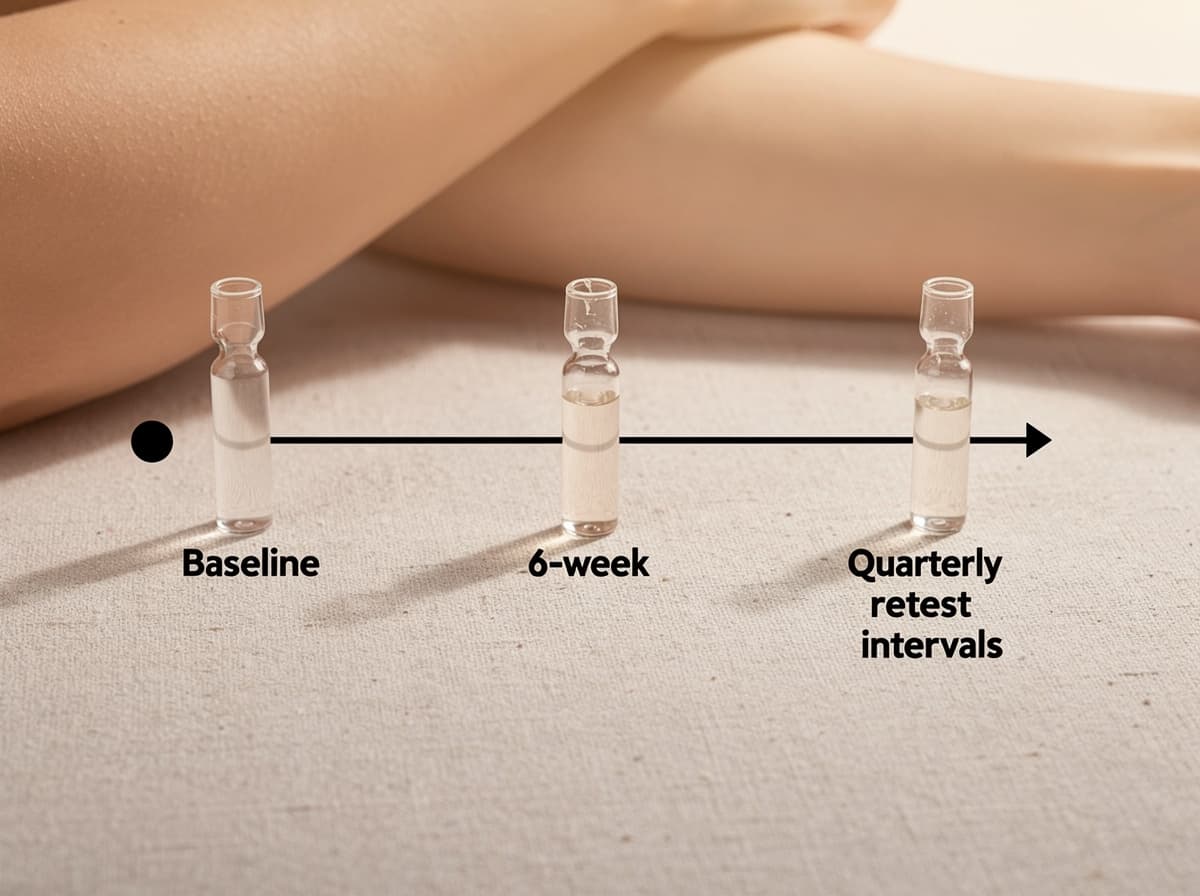
- Retest cadence: baseline, 6-week check-in, then every 3 months for systemic protocols.
- Population reference ranges are wide by design. Personal baselines are the real reference point.
Why a baseline draw is the whole game#
Peptides act on the endocrine system, and the endocrine system does not care how good the user feels. Research has shown that IGF-1 results depend heavily on the assay and the reference range used, so a single value in isolation is difficult to interpret without a personal starting point measured the same way. That is the core argument for baseline testing: the numbers that follow only mean something when compared against the user's own pre-protocol values.
A person can feel excellent while fasting glucose quietly drifts upward on a GH secretagogue. Another can conclude a peptide "isn't working" when IGF-1 has in fact moved exactly as expected. Symptoms miss things that labs catch.
The baseline panel should be drawn fasted, in the morning, ideally 8 to 12 hours after the last meal, so that markers that shift with meals or time of day (glucose, insulin, cortisol, testosterone) are captured under standardized conditions. This makes every future draw a like-for-like comparison rather than an apples-to-oranges guess.
The core baseline: what to draw if you test#
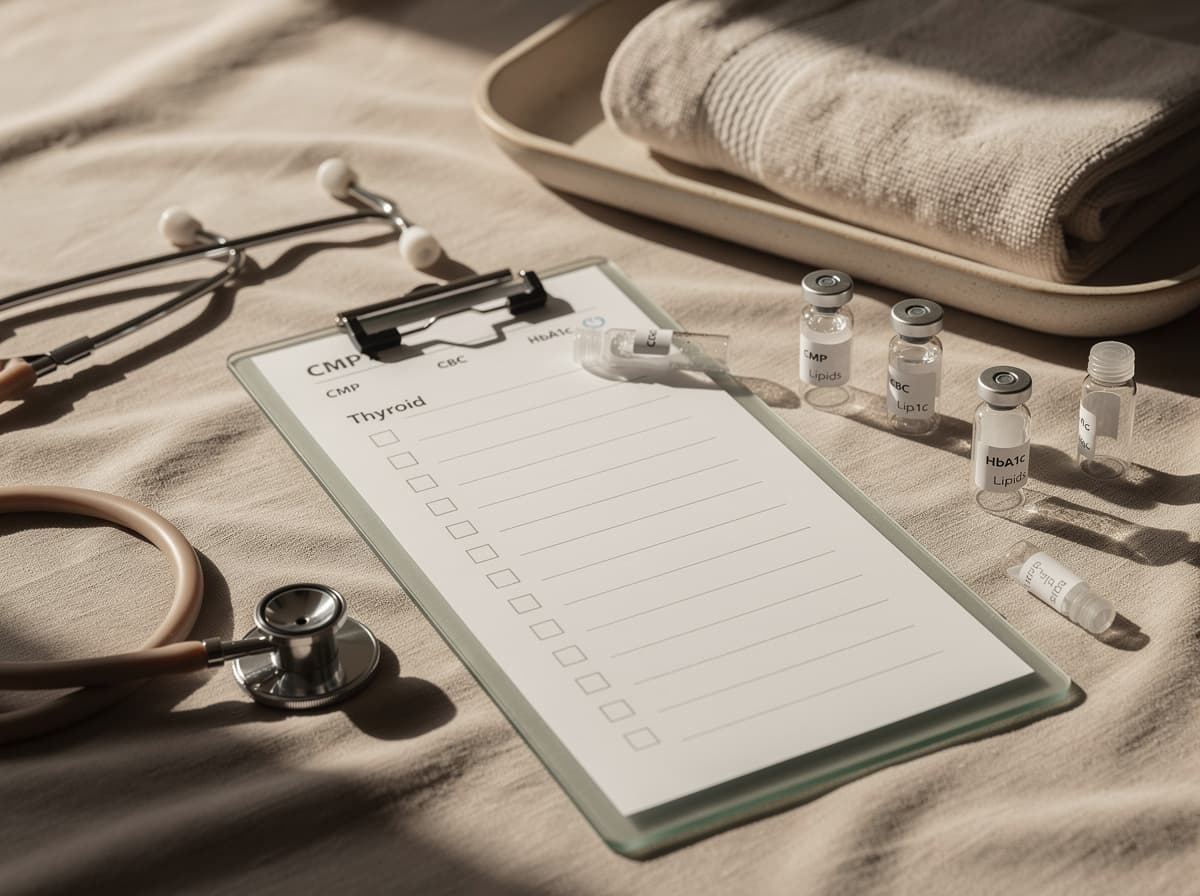
Regardless of which compound is planned, a core panel establishes systemic context:
- Comprehensive Metabolic Panel (CMP): liver enzymes (ALT, AST, bilirubin), kidney markers (creatinine, BUN, eGFR), electrolytes, fasting glucose.
- Complete Blood Count (CBC): baseline hematology to catch inflammatory or marrow signals early.
- Lipid panel: total cholesterol, LDL, HDL, triglycerides.
- HbA1c and fasting insulin: together these allow calculation of HOMA-IR, a proxy for insulin resistance.
- Thyroid panel: TSH, free T3, free T4.
- Sex hormones (optional but useful): total and free testosterone, estradiol, SHBG.
Liver and kidney markers matter because these organs clear peptides and their metabolites. Organ problems on peptides are uncommon, but tracking ALT, AST, creatinine, and eGFR is what turns a rare event into a detectable one.
Growth hormone secretagogues: IGF-1 is the marker that matters#
For CJC-1295, ipamorelin, sermorelin, and tesamorelin, IGF-1 is the workhorse. Growth hormone itself is pulsatile: a single draw is largely uninformative because levels swing throughout the day based on sleep, exercise, and stress. IGF-1 integrates GH signaling over days to weeks, which is why it is the standard efficacy readout.
Reference ranges are age- and sex-specific and differ between assays, so read your result against the range your lab reports (US labs usually report ng/mL; some European labs use nmol/L, where 1 ng/mL is about 0.131 nmol/L). A standard way to compare across ages is the SDS (standard deviation score); Klarovel computes it from the large Bidlingmaier 2014 reference study when your age and sex are known. Population ranges are wide; the personal baseline is what matters.
The FDA prescribing information for tesamorelin (Egrifta SV) instructs clinicians to monitor IGF-1 levels during therapy and to consider discontinuation with persistent elevations exceeding 3 standard deviation scores, particularly when efficacy response is not robust. That threshold, ~3 SDS above the age-matched mean, is the ceiling research users should treat as a hard stop.
A workable cadence for GH secretagogue protocols is IGF-1 at baseline, around 6 weeks, and every 3 to 6 months thereafter. Fasting glucose belongs on the same panel because GH has been shown to worsen insulin sensitivity (in the MK-677 trial in older adults, fasting glucose rose and insulin sensitivity fell), and that shift is only visible when both markers are tracked in parallel.
GLP-1 protocols: lipase, HbA1c, and kidney watchfulness#
The monitoring logic for GLP-1 receptor agonists (semaglutide, tirzepatide) is not speculative; it follows the warnings in the FDA labels, even though the labels do not prescribe a routine lab schedule.
The Wegovy prescribing information explicitly warns that acute pancreatitis, including fatal and non-fatal hemorrhagic or necrotizing forms, has been observed in patients treated with GLP-1 receptor agonists, and that patients should be observed carefully for persistent severe abdominal pain radiating to the back. The label further states that if acute pancreatitis is suspected, semaglutide should be discontinued promptly, and if confirmed, it should not be restarted.
Lipase is the most useful lab marker here. It is more specific to the pancreas than amylase and stays elevated longer after injury. A rise above 3 times the upper limit of normal, particularly with upper abdominal pain, is associated with acute pancreatitis and warrants immediate clinical evaluation. That said, the semaglutide labels report modest average increases in lipase and amylase on treatment, which do not by themselves indicate pancreatitis. Magnitude and symptoms decide.
Kidney function belongs on the follow-up panel. The FDA prescribing information for semaglutide notes that acute kidney injury has been reported in patients on GLP-1 receptor agonists, most commonly in those who became dehydrated from GI side effects, and advises monitoring kidney function in patients with renal impairment who report severe GI reactions. A clear drop in eGFR from baseline, or creatinine climbing above range, is a reason to talk to the prescriber promptly.
HbA1c provides a 2-3 month average of glycemic control, which allows dose optimization across the slow titration schedules typical of GLP-1 protocols.
Healing and immune peptides: a lighter, still-real footprint#
For BPC-157, TB-500, and thymosin alpha-1, the monitoring logic shifts. Short, localized protocols may not require an extensive quarterly panel. hs-CRP and other inflammatory markers can be useful to track when a protocol targets injury recovery or systemic inflammation.
One principle holds regardless: the longer a systemic peptide is run, the more useful it becomes to confirm that organ-stress markers have not shifted. If you are testing, a protocol beyond 8 weeks is a good point for a CMP and CBC recheck, even if the compound is considered "gentle."
Retest cadence: when to draw again#
A general framework, if you are testing:
- Baseline: before the first dose.
- Mid-cycle check-in: 4 to 6 weeks in. This catches early drift before it becomes a problem.
- End-of-cycle draw: compared directly against the baseline number.
- Ongoing protocols: every 8-12 weeks for GH secretagogues and GLP-1s.
Draws should be fasted (8-12 hours) and taken in the morning to preserve comparability. If the protocol changes (dose, compound, cycle length), the retest clock effectively resets.
Reading results: personal reference beats population reference#
Population reference ranges are wide because they must fit millions of people. A value that sits in the middle of the range for the population may still represent a meaningful shift for the individual. This is why the baseline matters so much: a 40% climb in IGF-1 that stays "within range" is a real pharmacological signal, not a normal reading.
Two decision principles worth internalizing:
- Symptoms outrank labs. If a protocol feels wrong, the labs being "fine" is not permission to continue. Stop and consult a clinician.
- Trends outrank single values. One out-of-range result on one draw is a data point. The same result on two consecutive draws is a trend that requires action.
Klarovel builds the protocol layer from your health profile, and each protocol includes a suggested monitoring plan (baseline panels, retest timing and thresholds) for those who choose to test. Klarovel does not sell or stock peptides; the disclosures page sets out what it does and does not do.
Build the protocol before the first dose#
The users who get the most out of peptide research are the ones who set up the monitoring before the first vial is opened, not after. If you test, that means a baseline panel drawn fasted, a clinician who will read the results, and a retest cadence written into the protocol from day one. Klarovel makes that layer easier: protocols built from your health profile, dosing math, and a monitoring plan you can act on whenever you choose to add labs. Start with the peptide calculator, review how it works, and register to plan the panel before the protocol begins.
Frequently asked questions
Keep reading
Buying Peptides in Norway: Customs and Legal Reality
Norwegian law bans mail-order medicinal products. Here is what Tollvesenet actually seizes, which peptides are on the doping list, and how to stay compliant.

Wegovy Side Effects: How Common, How Long, How Serious
What the Wegovy label and pooled STEP data actually report: incidence per side effect, median duration in days, and the one that does not fade.

Peptide Drug Interactions: What Research Actually Shows
Peptide drug interactions remain understudied. Here is what current research suggests about GLP-1 agonists, GH secretagogues, and repair peptides.