

Peptide drug interactions sit in an uncomfortable regulatory gap. Small molecules have decades of interaction data; biologics have their own framework; peptides fall somewhere in between, and the guidelines are still being written. This post walks through what research suggests about the interaction profile of the major peptide classes, and where the honest answer is still "we do not know."
Key takeaways#
- FDA labeling analysis found drug-drug interaction information present for only 49% (26 of 53) of approved peptide products, signaling a significant evidence gap.
- GLP-1 receptor agonists slow gastric emptying and can delay the absorption of oral medications; overall exposure is usually preserved but timing effects matter for narrow-therapeutic-index drugs.
- Oral semaglutide (Rybelsus) increased total thyroxine exposure by 33% when given with levothyroxine in a label study, one of the few clinically meaningful GLP-1 interactions on record.
- Tirzepatide can reduce oral contraceptive effectiveness after the first dose and each dose increase; a backup barrier method is recommended for 4 weeks.
- BPC-157, TB-500, and most growth hormone secretagogues have essentially no formal human interaction data; open questions exist with anticoagulants, insulin, and immunosuppressants.
Peptides sit between small molecules and biologics, and interaction rules follow#
Peptides are not small-molecule drugs, and they are not monoclonal antibodies. That in-between status is exactly why interaction assessment is messy. A 2023 EFPIA white paper noted that drug-drug interaction assessments are well defined in health authority guidelines for small molecule drugs and FDA draft guidance is now available for therapeutic proteins, but there are currently no regulatory guidelines outlining DDI assessments for therapeutic peptides, which poses significant uncertainty during drug development for this heterogeneous class. The FDA itself acknowledged the gap and, in a draft guidance on Clinical Pharmacology Considerations for Peptide Drug Products, stated that the document will describe the FDA's current thinking regarding the impact of clinical pharmacology considerations, including hepatic impairment, drug-drug interactions, QTc prolongation risk, and immunogenicity risk on a peptide drug product's pharmacokinetics, safety, and efficacy.
The practical implication is that when a clinician or researcher asks whether peptide X interacts with medication Y, the honest answer is often "there is no formal study." An FDA labeling review of peptides approved before July 2022 found that clinical pharmacology information was available in the labeling related to renal impairment for 57%, drug-drug interactions for 49%, immunogenicity for 40%, hepatic impairment for 38%, QT interval assessment for 34%, and mass balance for 17% of the 53 peptides examined. Roughly half of approved peptides ship without formal interaction data on the label.
GLP-1 receptor agonists shift oral drug absorption, mostly without dose-relevant consequences#
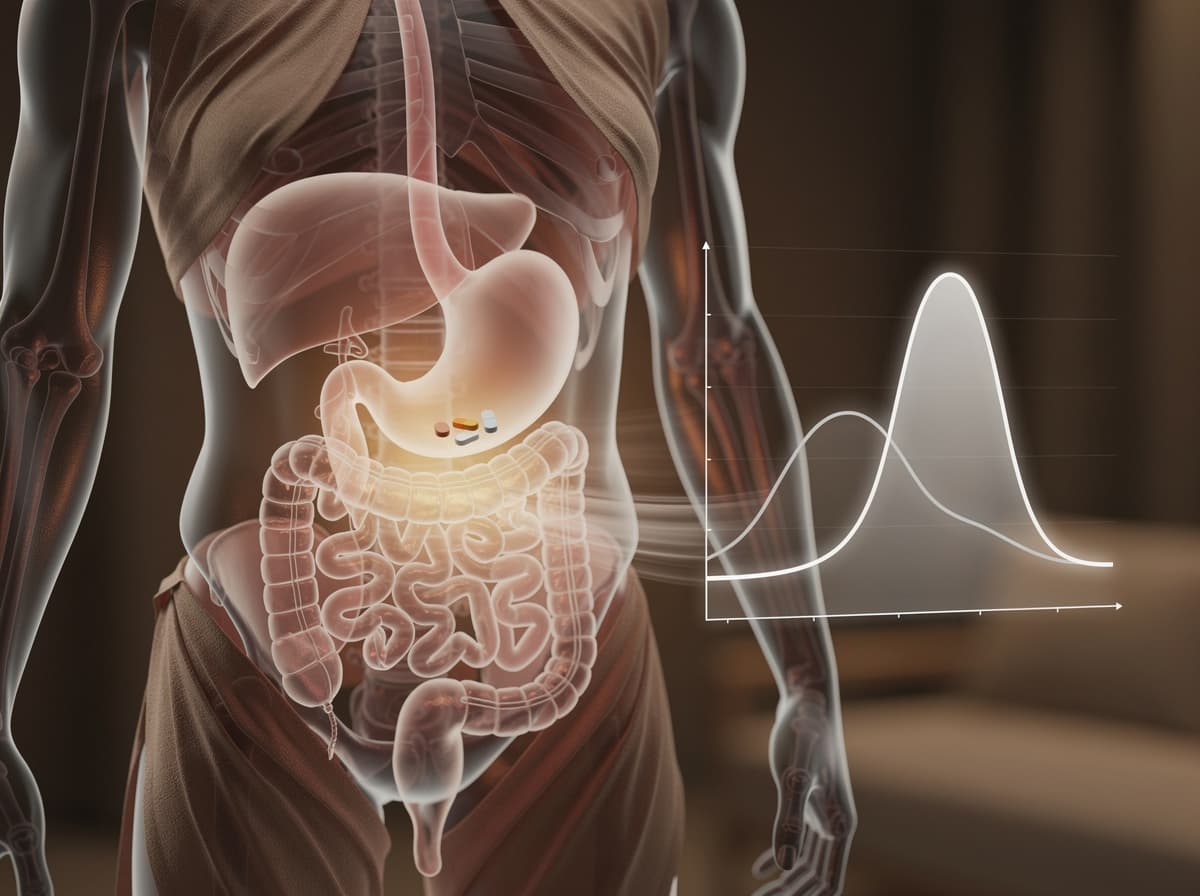
GLP-1 receptor agonists are the peptide class with the most robust interaction literature, largely because semaglutide, liraglutide, dulaglutide, and tirzepatide are now taken by millions of people, many on polypharmacy. The mechanism of interest is not enzyme inhibition; it is gastric emptying.
A 2024 systematic review in Drug Safety synthesized 22 pharmacokinetic reports and six prescribing sheets. Treatment with GLP-1 receptor agonists resulted in unaffected or reduced Cmax and delayed tmax of drugs with high solubility and permeability such as warfarin and contraceptive pills. The overall drug exposure was not considered clinically significant, and dose adjustments are probably not required for simultaneous use with oral medications, though results should be carefully generalized to cases of background kidney dysfunction or when using drugs with narrow therapeutic index.
Preliminary evidence and clinical pharmacology commentary point in the same direction. A clinical pharmacology perspective from Celerion noted that while many of the GLP-1 drug interactions investigated to date may be statistically significant, no dose adjustment is required because they were not found to be clinically relevant, with tirzepatide as the one exception. The reviewers also emphasized that the anticipated PK changes due to delayed gastric emptying depend on whether solubility or permeability is the overall rate-limiting step in absorption, and a clinically relevant effect will depend on the extent of PK changes and the therapeutic index of the co-administered oral drug.
Two GLP-1 interactions that do change clinical practice#
Two exceptions to the "no dose adjustment needed" pattern deserve attention.
Oral semaglutide and levothyroxine. Levothyroxine has a narrow therapeutic index and is sensitive to gastric conditions. In the interaction study reported in the Rybelsus (oral semaglutide) label, total thyroxine exposure (adjusted for endogenous levels) increased by 33% when levothyroxine was given with oral semaglutide, and the label advises considering increased clinical or laboratory monitoring for narrow-therapeutic-index drugs. Case reports have also described suppressed TSH after starting GLP-1 therapy. The practical risk is over-replacement (iatrogenic hyperthyroidism) if TSH is not rechecked.
Tirzepatide and oral contraceptives. Per the Mounjaro and Zepbound labels, tirzepatide may reduce the efficacy of oral contraceptives due to delayed gastric emptying; the delay is largest after the first dose and diminishes over time. Patients taking oral contraceptives who are prescribed tirzepatide should be advised to switch to a non-oral contraceptive method or add a barrier method for at least 4 weeks after starting and for 4 weeks after each dose increase.
Warfarin, statins, ACE inhibitors, digoxin, and combined oral contraceptives with weekly GLP-1 agonists (not tirzepatide) have all been examined. The 2024 Drug Safety review found these combinations largely dose-neutral. Where fast absorption matters, timing helps: the exenatide (Byetta) label, for example, advises taking oral medications that depend on threshold concentrations, such as contraceptives and antibiotics, at least 1 hour before the injection.
Growth hormone peptides intersect awkwardly with insulin and glucose control#
Growth hormone secretagogues (GHRH analogs like CJC-1295; ghrelin mimetics like ipamorelin, GHRP-2, GHRP-6, and MK-677) act at the pituitary rather than through hepatic enzymes. The interaction profile that matters is metabolic, not pharmacokinetic.
Growth hormone is counter-regulatory to insulin. A 2021 review on insulin and pituitary axes documented that cortisol and growth hormone are potent insulin-antagonistic hormones, and impaired glucose tolerance, elevated fasting glucose concentrations and diabetes mellitus are frequent in Cushing's disease and acromegaly. Sustained elevation of GH from secretagogues can reduce insulin sensitivity: in the two-year MK-677 trial in older adults, fasting glucose rose and insulin sensitivity fell. Ghrelin receptor agonism itself has direct metabolic effects: in human infusion studies, ghrelin raised glucose levels in healthy subjects and inhibited insulin secretion.
For someone on insulin, sulfonylureas, or GLP-1 agonists for diabetes management, a GH-axis peptide can shift glycemic control, mostly toward higher glucose through GH-mediated insulin resistance and ghrelin-mimetic effects on insulin secretion. This is not a documented DDI in the pharmacokinetic sense. It is a pharmacodynamic interaction that is biologically plausible and worth monitoring with fasting glucose, HbA1c, and, in ambiguous cases, a fasting insulin panel.

Repair peptides: BPC-157 and TB-500 sit in an evidence vacuum#
BPC-157 and TB-500 are the peptides most likely to raise interaction questions from users, and the peptides with the least formal answer. A 2025 GlobalRPh review of both compounds was blunt: data on the pharmacokinetic profiles of both peptides remain extremely limited, with minimal characterization of their absorption, distribution, metabolism, and elimination parameters. This absence of foundational pharmacokinetic information constitutes a major knowledge gap with direct implications for clinical application, dosing strategies, and safety monitoring. Similarly, evidence concerning potential drug-peptide interactions is largely unavailable.
The theoretical concerns that come up most often:
- Anticoagulants and antiplatelets. Both peptides are pro-angiogenic, and there is no human data on combining either with warfarin, DOACs, heparin or antiplatelet drugs. The animal data on BPC-157 actually points the other way from the usual worry: in a 2012 rat study, BPC-157 reduced bleeding time and thrombocytopenia after tail amputation in rats given heparin, warfarin or aspirin, without changing heparin's anti-Xa activity. Rat hemostasis is not human hemostasis, so the honest position is "unknown in humans": Klarovel's engine flags anticoagulant use with both peptides and recommends coagulation monitoring.
- Psychotropics. BPC-157 modulates dopamine, serotonin, and GABA in animal work. Interactions with SSRIs, benzodiazepines, or opioids have not been formally studied in humans.
- Immunosuppressants. TB-500 modulates immune cell migration. Coadministration with calcineurin inhibitors, biologic immunomodulators, or high-dose corticosteroids is not characterized.
BPC-157 and TB-500 are not FDA-approved drugs and are not dispensed through pharmacies, which means the interaction check that would ordinarily happen at dispensing does not happen at all. If someone is running a repair peptide protocol while on prescription medications, that reconciliation has to be done manually by the prescribing clinician.
Klarovel treats this reconciliation as part of the protocol layer: the intake questionnaire asks for current medications, and the engine checks them against a drug-interaction table that adds cautions and monitoring to the protocol. See also how the platform is structured and what Klarovel does and does not do under disclosures.
Metabolism-based interactions are rare for peptides, but not zero#
The reflex when discussing drug interactions is to reach for CYP450. For most peptides, that reflex is misleading. A 2025 follow-up analysis of therapeutic peptides approved 2021 to 2024 examined nine new peptide drugs and found that all nine peptides investigated CYP inhibition in human liver microsomes, with low risk identified for larger peptides above 2 kDa, and all nine assessed CYP induction in human hepatocytes, with one peptide (danicopan) showing a risk in vitro. In general, peptides are catabolized by ubiquitous peptidases into amino acids rather than by hepatic CYP enzymes.
The clinically relevant exceptions tend to be small peptidomimetics that behave more like small molecules than like proteins. Nirmatrelvir, the SARS-CoV-2 protease inhibitor in Paxlovid, is the paradigm case: it is a peptidomimetic metabolized by CYP3A4, so it is co-packaged with ritonavir, a strong CYP3A4 inhibitor that boosts its levels, and that pairing carries a long list of CYP3A4-based interactions. When the "peptide" is small enough and lipophilic enough to be handled by hepatic enzymes, small-molecule interaction rules apply.
The heuristic: the larger and more protein-like the peptide (semaglutide, tirzepatide, dulaglutide), the less likely a CYP-based interaction and the more likely a physiology-based one (gastric emptying, immunogenicity, receptor-level effects). The smaller and more small-molecule-like (nirmatrelvir, some cyclic peptides), the more standard CYP and transporter screening applies.
What a defensible interaction check looks like in practice#
The framework we use for protocol design at Klarovel is a five-step reconciliation:
- List every peptide, every prescription, every OTC. Include supplements with pharmacologic activity (St. John's wort, high-dose fish oil, red yeast rice).
- Identify the mechanism of each peptide. GLP-1 agonism? GHRH/GHS? Angiogenic? Immunomodulatory? Peptidomimetic?
- Ask three questions. Does the peptide slow gastric emptying? Does it alter glucose homeostasis? Does it affect coagulation, angiogenesis, or immune function?
- Screen each prescription against those three axes. Levothyroxine, oral contraceptives, and narrow-therapeutic-index drugs against gastric emptying. Insulin, sulfonylureas, and GLP-1 agonists against glucose axis. Anticoagulants, antiplatelets, and immunosuppressants against angiogenesis and immune modulation.
- Confirm with the prescriber. A pharmacist-led medication review with the peptide list included is the minimum standard when polypharmacy is present.
Bottom line: assume interaction until data proves otherwise#
The peptide field is generating pharmacology faster than regulators can write guidance. That means every serious protocol should include an honest interaction reconciliation, not a database lookup that returns "no results found" and calls it safe. GLP-1 agonists have real, documented effects on levothyroxine and oral contraceptives. GH secretagogues collide with glucose regulation. Repair peptides sit in an evidence vacuum where absence of published harm is not evidence of absence.
If you want to run a peptide protocol alongside prescription medications, do the reconciliation properly. Register with Klarovel to start with a structured intake that captures every concomitant medication, or read the related post on peptide safety fundamentals before you order a single vial.
Frequently asked questions
Keep reading
Buying Peptides in Norway: Customs and Legal Reality
Norwegian law bans mail-order medicinal products. Here is what Tollvesenet actually seizes, which peptides are on the doping list, and how to stay compliant.

Wegovy Side Effects: How Common, How Long, How Serious
What the Wegovy label and pooled STEP data actually report: incidence per side effect, median duration in days, and the one that does not fade.

Peptide Bloodwork Panel: The Baseline Labs That Matter
A research-grade guide to peptide bloodwork panels: which markers to draw, when to retest, and how to read IGF-1, lipase, and metabolic shifts safely.