
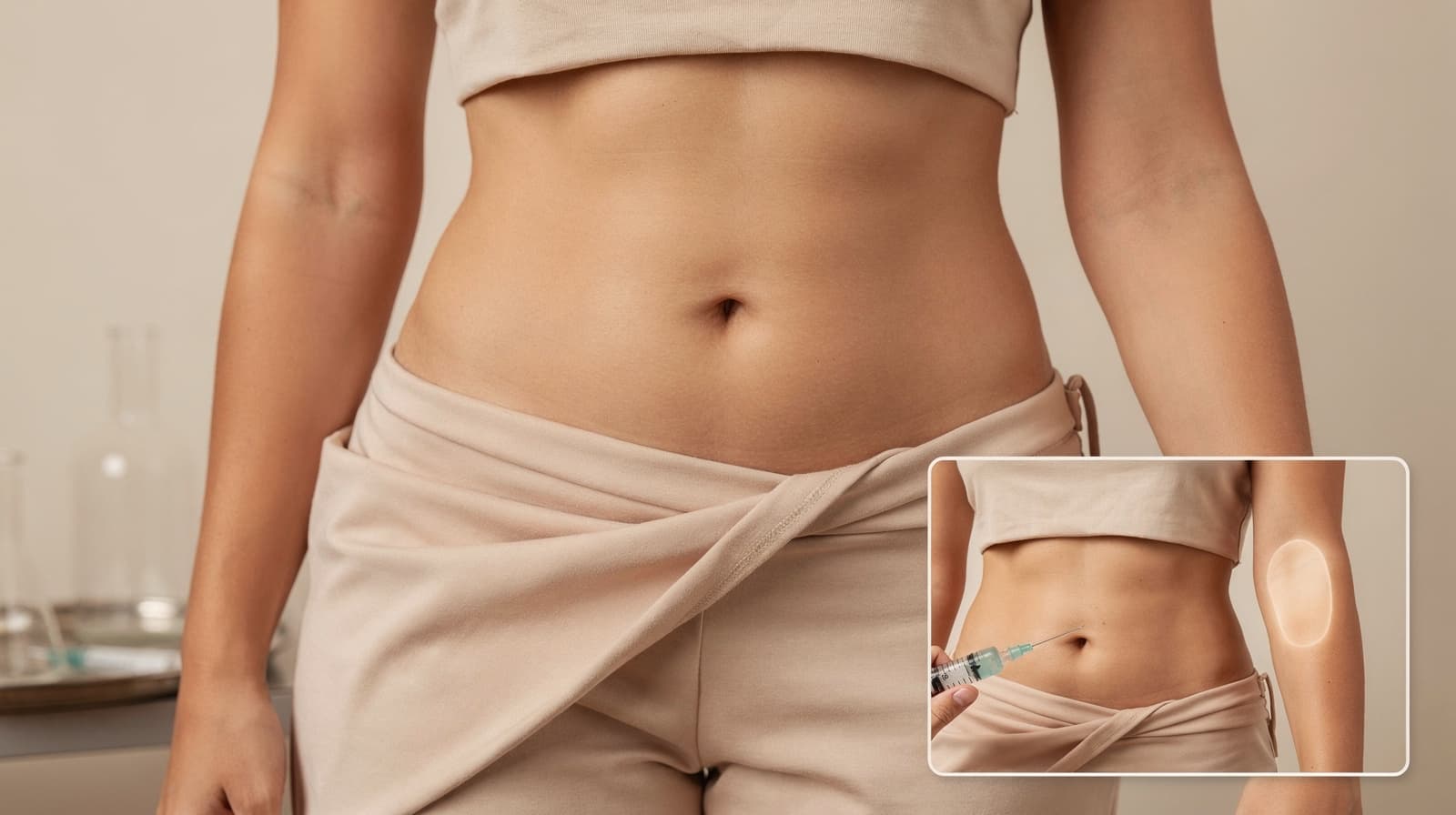
Most peptide users default to a single comfortable injection spot and stay there for months. That choice quietly shapes absorption, comfort, and the long-term health of the tissue under the needle. This guide walks through the four practical subcutaneous zones, what each does to pharmacokinetics, and how to rotate without thinking about it.
Key takeaways#
- The four standard subcutaneous zones for peptide injections are the abdomen, the anterior or outer thigh, the back of the upper arm, and the deltoid region of the shoulder.
- For insulin and many short peptides, abdominal injection produces faster and higher peaks than the thigh, while total exposure (AUC) is often comparable. For semaglutide, the FDA label states that exposure is similar in the abdomen, thigh and upper arm.
- Incorrect site rotation is the single strongest documented risk factor for lipohypertrophy, the rubbery lump that distorts absorption over time.
- Each zone has a usable area of several square inches; spacing injections at least 1 cm (about a fingerbreadth) apart inside a zone, and waiting about four weeks before reusing the exact spot, is what actually protects tissue.
- For short-acting compounds, site choice can match the goal: faster onset favors the abdomen; slower, steadier release favors thigh or buttock. For long-acting weekly peptides, site matters less than rotation.
Why the injection site matters more than most users think#
Peptides and proteins do not behave like small-molecule pills. Subcutaneous absorption depends on local blood flow, lymphatic drainage, fat thickness, and tissue health. A 2021 ScienceDirect review of FDA bioavailability data found that some subcutaneously administered therapeutic proteins and peptides such as insulins, human growth hormone, and monoclonal antibodies exhibit a different extent and rate of absorption when administered from distinct injection sites . That same survey covered 19 immunoglobulin G antibodies, 18 peptides and small proteins under 16 kDa, and 8 non-IgG proteins with clinical pharmacokinetic data from multiple subcutaneous injection sites , making it one of the better cross-product datasets available.
The practical effect of site selection varies by molecule. For insulin and many short peptides, the abdomen wins on speed. For semaglutide, the FDA label states that "similar exposure is achieved" in the abdomen, thigh or upper arm. The principle stays the same: pick a site that matches the goal, rotate it on a schedule, and check the tissue.
The abdomen is the fastest and most forgiving site#
The abdomen is the most studied subcutaneous zone. It offers a thick, even fat layer, dense capillary supply, and enough surface area for months of rotation. Common patient guidance is to inject at least 5 centimeters (about two inches) from the navel, and to avoid the waistline where clothing rubs.
Pharmacokinetic studies have shown a measurable speed advantage. A classic 1982 Diabetologia trial reported that insulin was absorbed faster from the abdomen than from the thigh under resting conditions and during exercise. A later review summarized by the Journal of Diabetes Research found that injection into the abdominal region produced greater and earlier peak concentrations than the deltoid and thigh in healthy subjects, with the time to maximum plasma concentration after abdominal injection being less than half that of the two other sites, and Cmax reduced by 32% in the thigh and 42% in the deltoid . In people with diabetes, Cmax has been reported to be 28% higher and occur more than twice as fast upon injection of human insulin into the abdomen compared to the thigh .
What this means in practice: the abdomen is the default starting zone, and for short-acting compounds it gives the quickest onset. Stay outside the 5 cm peri-umbilical ring, keep injections at least one finger-width (about 1 cm) apart, and use the left and right sides as separate quadrants.
The thigh is the slower, steadier alternative#
The anterior and outer thigh is the second most common zone, mainly because it is easy to self-inject and easy to see. Skin and fat thickness are slightly lower than the abdomen, and blood flow is lower at rest. A 2022 needle-free insulin study measured skin thickness of 2.45 mm at the abdomen, 2.18 mm at the upper arm, and 1.93 mm at the thigh, with a significant difference between abdomen and thigh.
That lower perfusion translates to slower absorption for insulin: absorption from subcutaneous thigh tissue is slower than from the abdominal wall, a finding examined in a randomized trial in type 1 diabetes that compared subcutaneous abdominal, subcutaneous thigh, and intramuscular thigh injection of soluble insulin. For short-acting compounds where a sharp peak is the goal, the thigh is the wrong default; where a gentler release is preferred, it is the better one. For long-acting weekly GLP-1s the difference largely disappears.
Anatomically, the usable zone runs from roughly four finger-widths above the knee to four finger-widths below the groin crease, on the outer front of the thigh, avoiding the inner thigh where larger vessels run closer to the surface.
The upper arm gives an intermediate profile, with caveats#
The back of the upper arm (triceps region) sits between abdomen and thigh in most pharmacokinetic surveys. It has thinner subcutaneous fat than the abdomen in many people, especially in lean users, so a pinch technique becomes essential to avoid intramuscular delivery. Preliminary evidence from needle-free insulin work showed no significant difference in glucose infusion rate area under the curve between abdomen, upper arm, and thigh, so for some compounds the arm performs as a reasonable abdominal substitute.
The two practical problems with the upper arm are self-access and fat depth. Self-injecting the back of the contralateral arm is awkward; many users rely on a partner or lean against a chair to pivot the arm forward. In leaner users, the available pinch may be less than 1 cm, which raises the risk of inadvertent intramuscular delivery and a faster, less predictable response.
A 2023 Phase 1 study on lenacapavir, a long-acting subcutaneous antiretroviral, enrolled ten participants each into thigh, upper arm, and abdomen cohorts to compare pharmacokinetics across body sites. Thigh exposure was similar to the abdomen, and upper-arm exposure was higher (Cmax 42% and AUC 22% above the abdomen), differences the investigators did not consider clinically significant. Lenacapavir is a small molecule, not a peptide, so the lesson is general: head-to-head site data is rare, results vary by compound, and when fat depth is adequate the arm is a defensible rotation target.
The deltoid and shoulder are niche, not default#
The deltoid is sometimes lumped together with "upper arm" but anatomically refers to the rounded shoulder muscle, not the triceps. For most peptides, the deltoid is not a standard self-administered subcutaneous site. Subcutaneous fat over the deltoid is usually thin; the underlying muscle is close to the skin; and the risk of intramuscular delivery is meaningful. In one insulin study summarized in a 2018 review, deltoid injection produced a 42% lower Cmax than abdominal injection, although total exposure did not differ significantly and other insulin data rank the arm ahead of the thigh.
Where the deltoid does appear is in industry protocols for specific drug products. Insulin lispro studies have used the abdominal wall, thigh, and deltoid as the three comparison sites for pharmacokinetic equivalence work. For most peptide users, the practical rule is simpler: use the back of the upper arm (triceps), not the rounded shoulder, and reserve true deltoid injection for IM-formulated products administered by a clinician.
Rotation is the single highest-impact habit#
If only one habit is taken from this guide, it should be structured rotation. The evidence is unusually clear. A Spanish study of 430 insulin-injecting outpatients found that nearly two-thirds (64.4%) had lipohypertrophy, and of those who rotated sites correctly, only 5% had lipohypertrophy, while 98% of those with lipohypertrophy either did not rotate or rotated incorrectly. A 2025 systematic meta-analysis of 51 studies has shown that the strongest contributor to lipohypertrophy was incorrect injection site rotation, with a pooled odds ratio of 8.85, followed by needle reuse at 3.20.
Lipohypertrophy is not cosmetic. It changes how the next injection is absorbed. Studies have shown that injection into lipohypertrophied tissue produced a 25% decrease in insulin Cmax and a 22% decrease in 4-hour exposure compared to injection into normal abdominal tissue. For a weekly GLP-1 or growth hormone peptide, that variability is enough to make a protocol feel inconsistent without any obvious cause.
A workable rotation rule for most users:
- Divide each zone into a grid (four quadrants per side of the abdomen, three bands on each thigh, two bands on each upper arm).
- Use a new quadrant or band every injection, working clockwise through the available sites.
- Wait at least four weeks before reusing the exact same point.
- Inspect every site weekly by sight and by gentle palpation. Lumps, hardness, or persistent redness are signs to stop using that area for at least two to three months.
A notebook or phone note that records the site of each dose is enough to keep the schedule honest.
Comfort and absorption depend on temperature and technique#
Site choice is necessary but not sufficient. Two technique details have outsized effects on pain and absorption.
First, temperature. Cold solution straight from the refrigerator tends to sting more, and skin temperature affects absorption (warming an insulin injection site speeds uptake). The Wegovy instructions suggest you may let the pen reach room temperature before injecting; for a reconstituted vial, drawing the dose and letting the syringe warm briefly in your hand does the same job without leaving the whole vial out of the fridge. The same applies to alcohol swab residue: let the skin air-dry fully before insertion.
Second, depth. Most modern insulin pens use 4-6 mm needles, and the shortest insulin syringe needle is 6 mm. The international FITTER recommendations say that with any syringe needle, slim to normal-weight adults should inject into a lifted skinfold, and that a 45-degree angle with a 6 mm needle is an acceptable substitute for the fold. The goal is to deposit the peptide into adipose tissue, not muscle, where insulin absorption is faster and less predictable; FITTER advises avoiding intramuscular injection for exactly that reason.
For a deeper walkthrough of needle gauge and angle selection, see the injection technique primer; for how Klarovel builds a protocol, see how it works, and the Klarovel disclosures page for the limits of wellness-grade guidance.
For the full sequence rather than the site map, see how to inject peptides. For needle gauge, angle and aseptic handling, see the injection technique primer.
A protocol is only as good as the spot it lands in#
Peptide outcomes are usually attributed to the molecule. In practice, they are shaped just as much by where the needle goes and how often that spot has been used before. Pick a zone that matches the goal, rotate on a schedule, inspect the tissue weekly, and the protocol does what it was designed to do. Site selection is one piece of what peptide therapy involves. Work out each draw with the Klarovel peptide calculator, keep a simple site log from day one, and create a Klarovel account to build the protocol itself.
Frequently asked questions
Keep reading
Wegovy Pill Dosage Chart: Why 25 mg Is Not a Misprint
The oral Wegovy ladder runs 1.5 to 25 mg daily; the standard injection ladder runs 0.25 to 2.4 mg weekly. Same molecule, different scale, often conflated.

MOTS-C peptide dosage chart: doses, cycles and goals
A MOTS-C peptide dosage chart by experience level: starting dose, target, ceiling and frequency from Klarovel's curated dose table, plus timing and cycle.
Wolverine peptide stack: definition, doses and duration
The Wolverine peptide stack means BPC-157 plus TB-500. Some clinics extend it to four compounds. Dosing tables for both readings, and the cycle length.