
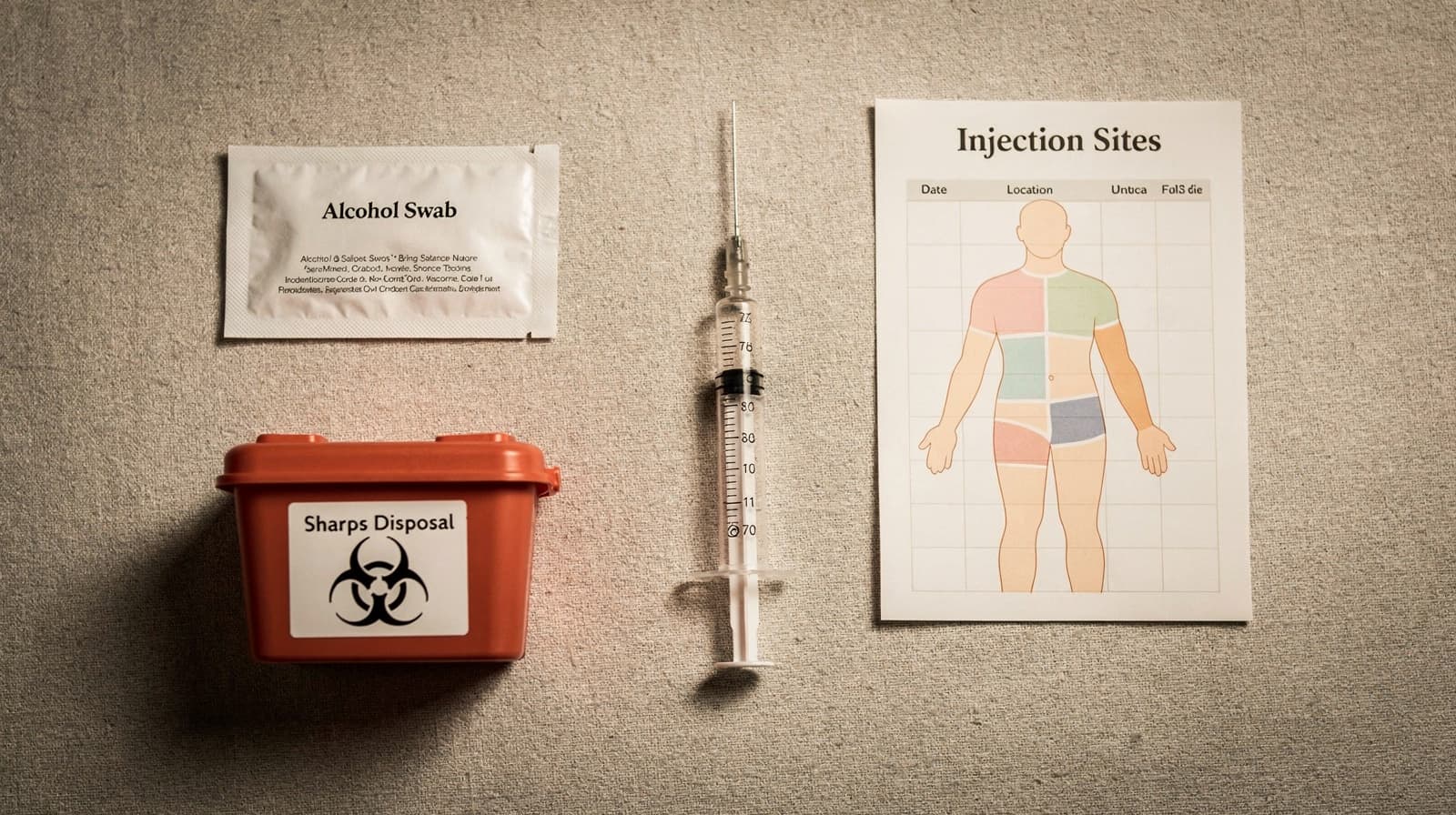
Most peptide-protocol failures are not pharmacology failures. They are technique failures: a needle placed too deep, a site reused until the tissue scars, a vial swabbed with a dry alcohol pad. This primer covers what the subcutaneous-injection literature actually shows about angle, gauge, rotation, and sterility, and how a researcher should translate that into a repeatable handling protocol.
Key takeaways#
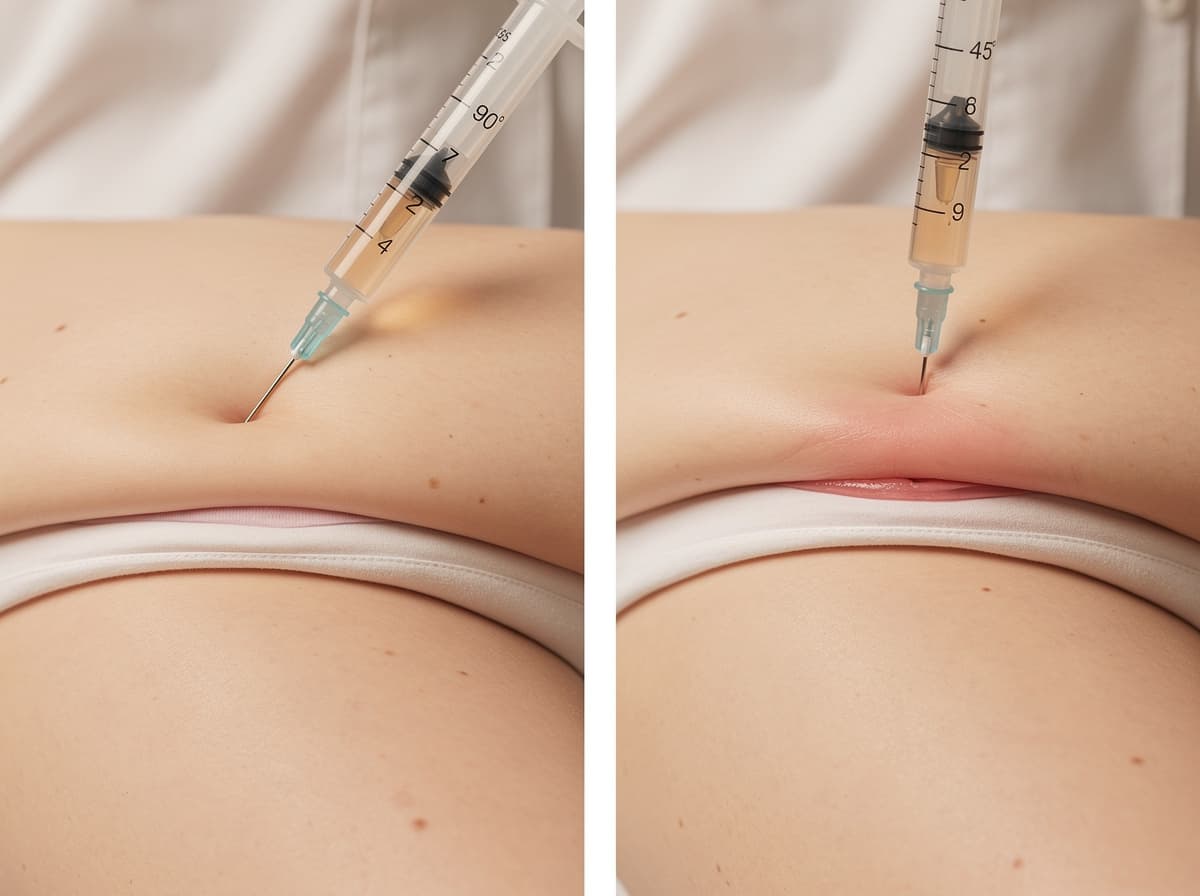
- Subcutaneous injection angle is dictated by tissue depth, not preference: 90° when a 2-inch skinfold is easy to pinch, 45° when only ~1 inch can be grasped.
- Needle length matters more than gauge for depth control. The international FITTER recommendations call 4 mm pen needles and 6 mm syringe needles the safest first choice; 8 mm (5/16") syringe needles are common but need a lifted skinfold in slim to normal-weight adults.
- Lipohypertrophy (firm, rubbery subcutaneous nodules) is the single most predictable long-term complication of repeated injections into the same spot, and rotation across a postcard-sized area is the most evidence-supported countermeasure.
- Massaging the site after withdrawal is discouraged; it can change absorption kinetics and contribute to bruising.
- Sharps must be disposed of in a rigid, puncture-resistant container, never recapped, never in household trash.
Why injection technique is a protocol-literacy issue, not a clinical one#
Klarovel does not sell, source, or fulfill peptides. How an injection is handled determines whether the protocol layer (timing, dose-spacing, cycle structure) means anything at all. If absorption is erratic because the same square inch of abdominal tissue has been hit forty times, the elegance of the dosing schedule is irrelevant.
The subcutaneous (SC) route is the standard for most peptide research because it deposits material into the adipose tissue layer beneath the dermis, where blood flow is low and absorption is slow and sustained. Open educational sources on SC injection note that this tissue has few blood vessels, so substances administered via this route show a slow, sustained rate of absorption, which is why peptide pharmacokinetics behave so differently from oral or intramuscular routes.
The diabetes literature is the closest analogue (decades of data, millions of patients), and it consistently links poor technique, above all poor rotation and needle reuse, with lipohypertrophy and measurable absorption variability.
Angle, gauge, and depth: the three variables that decide where the peptide ends up#
The clinical consensus on subcutaneous injection angle is well documented. Nursing-skills references state that a 45- or 90-degree angle is used for a subcutaneous injection, with the steeper angle for normal or higher-BMI subjects and the shallower angle for thin individuals with less adipose tissue. The practical rule that has been shown to work across body types: if a 2-inch skinfold can be pinched between thumb and forefinger, 90° is appropriate; if only about 1 inch can be grasped, 45° lowers the risk of inadvertently depositing into muscle.
Needle length is the variable most people underweight. Manufacturer guidance from Lilly's subcutaneous injection reference indicates that needles 6 mm or less are recommended in most cases, and that 4-5 mm needles can deliver SC contents at 90° without a skinfold in many subjects. Longer needles (8 mm and above) generally require a skinfold and/or a 45° angle to limit the risk of depositing too deeply; the FITTER recommendations note that these once-standard lengths raise the risk of intramuscular injection without improving results. Gauge (28 G, 29 G, 30 G, 31 G) influences pain and back-pressure on the syringe plunger; it does not change depth. Thinner gauges hurt less but bend more easily if the injection is rushed.
Volume is the third constraint. Self-injected SC volumes are usually kept to about 1 mL per site; some approved products deliver more, but larger volumes tend to hurt more. If a protocol calls for more than 1 mL, splitting into two sites is the usual approach.
Site selection and rotation: the most under-rated determinant of consistent absorption#
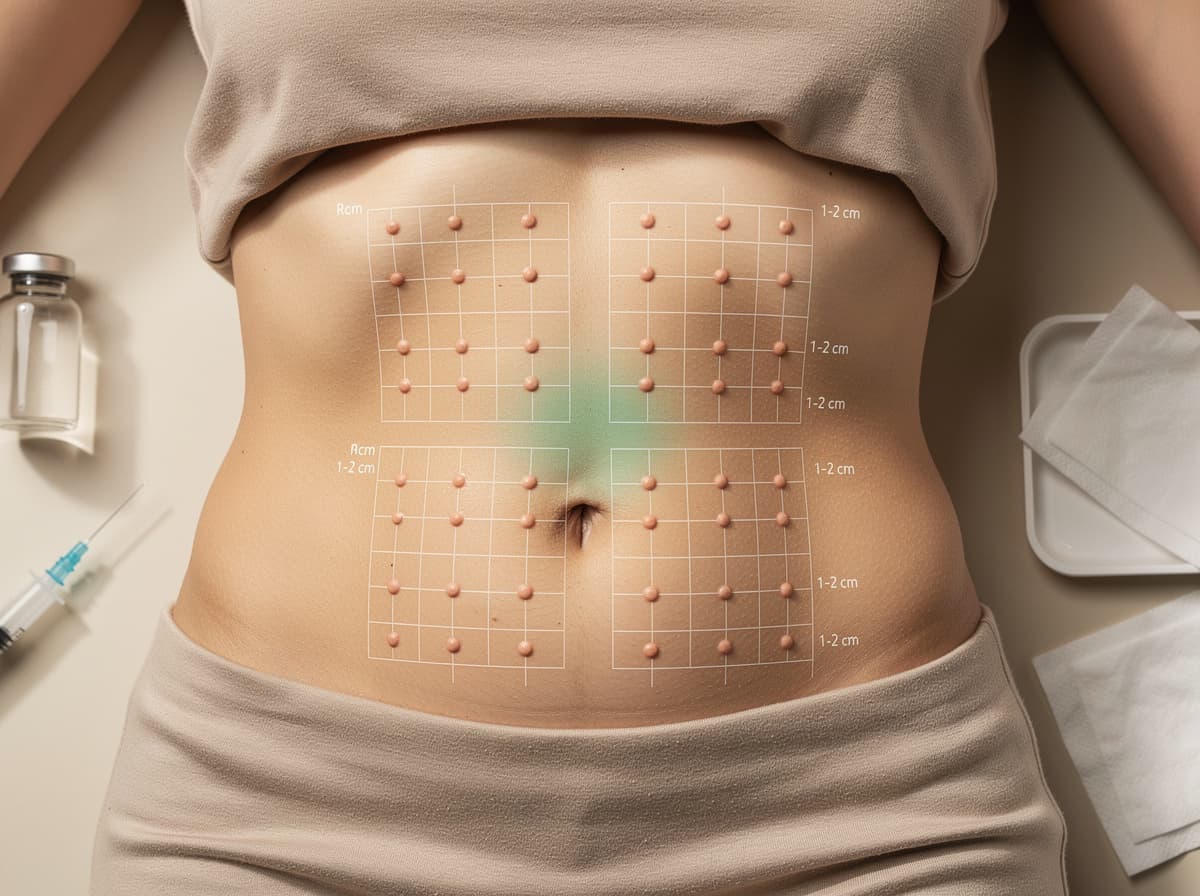
The standard SC sites are the abdomen (avoiding a ~5 cm radius around the navel), the outer aspect of the upper thigh, and the back of the upper arm. Absorption speed varies by site, at least for insulin: a 2018 review of insulin absorption summarizes it as fastest from the abdomen, slower from the arm, then thighs and buttocks (long-acting insulins are less site-sensitive, and for semaglutide the FDA label reports similar exposure at abdomen, thigh and upper arm). For anyone trying to keep pharmacokinetics consistent across a cycle, this means picking one anatomical region and rotating within it, rather than alternating between abdomen and thigh and confounding the variability of the compound with the variability of the site.
The rotation evidence is strong. A 2025 meta-analysis of 51 studies found incorrect site rotation was the strongest risk factor for lipohypertrophy (pooled odds ratio 8.85), followed by needle reuse (3.20). A separate Diabetes Technology Society review reports that almost half of insulin users have been found to have lipohypertrophy, and that common risk factors are failure to rotate sites, concentrating injections in a small area, and needle reuse. The same review notes that areas with injection-induced lipohypertrophy contain a significantly larger number of macro-adipocytes and fibrosis, which is why absorption from those sites becomes unpredictable.
A workable rotation scheme:
- Divide the chosen region (e.g., abdomen) into four quadrants.
- Space successive injections by at least 1 cm (one finger width), per the FITTER recommendations.
- Use one quadrant per week, then advance.
- Log each site (paper, calendar, or app) so you do not rely on memory.
- Visually inspect and palpate sites weekly for firmness, dimpling, or rubbery nodules.
Both leading risk factors (poor rotation and needle reuse) are modifiable, which is why the FITTER recommendations put so much weight on teaching rotation from the first injection, and why single-use needles are the standard.
The aseptic sequence: a step list that survives contact with reality#
Aseptic technique is not theatre. It is the sequence that keeps the bioburden on the needle, the stopper, and the skin low enough that the SC tissue can clear it without local inflammation. The skeleton of the sequence, distilled from open nursing references and pharmaceutical manufacturer documentation:
- Hand hygiene. Soap and running water for at least 30-60 seconds, then dry on a clean disposable towel.
- Surface setup. Clean a hard, non-porous surface. Lay out: vial, syringe, two alcohol swabs (70% isopropyl), gauze, sharps container.
- Vial preparation. Swab the rubber stopper with alcohol; allow it to dry. Drawing through a wet stopper has been associated with stinging and skin irritation at the injection site.
- Draw and inspect. Draw the prescribed volume. Tap and expel large air bubbles. Confirm the volume against the syringe markings.
- Site preparation. Select a site at least 1-2 cm from the previous one, outside any palpable nodule. Swab in a firm circular motion, then let the skin dry fully. Inserting into wet alcohol is uncomfortable and may introduce alcohol into the tissue.
- Insertion. Pinch (if needed), insert at the correct angle in a single smooth motion, release the pinch, then depress the plunger steadily.
- Withdrawal. Remove the needle at the same angle. Apply gentle pressure with sterile gauze. Open-source nursing protocols state explicitly: do not massage the site.
- Disposal. Engage the safety shield if present. Place the entire syringe-needle unit, uncapped, into a rigid puncture-resistant sharps container. Never recap, never re-use, never throw into household waste.
- Log. Record date, site quadrant, volume, lot if relevant, and any local reaction.
Injection-technique education is the main countermeasure the insulin literature recommends against these complications. The point is not perfection on any single dose; the point is repeatability across hundreds of doses.
For the procedure in order from start to finish, see how to inject peptides. For where each dose should land, see the site-by-site guide.
A clean technique is the silent variable behind every clean protocol#
The peptide-research community spends enormous attention on dose, timing, and stacking. It spends far less on the mechanics of getting the compound into tissue consistently. In a self-administered protocol, technique variance can be as large a source of noise as the compound itself. Match the angle to the tissue, rotate across a postcard-sized field, keep the sequence sterile, and log every site. Then, and only then, can the protocol layer be evaluated honestly, as part of the broader picture of what peptide therapy involves.
To plan a cycle around a repeatable technique baseline, register a free Klarovel account, use the peptide calculator to lock dose math before the first injection, and review how Klarovel works for the full research-context framing.
Frequently asked questions
Keep reading
Wegovy Pill Dosage Chart: Why 25 mg Is Not a Misprint
The oral Wegovy ladder runs 1.5 to 25 mg daily; the standard injection ladder runs 0.25 to 2.4 mg weekly. Same molecule, different scale, often conflated.
MOTS-C peptide dosage chart: doses, cycles and goals
A MOTS-C peptide dosage chart by experience level: starting dose, target, ceiling and frequency from Klarovel's curated dose table, plus timing and cycle.
Wolverine peptide stack: definition, doses and duration
The Wolverine peptide stack means BPC-157 plus TB-500. Some clinics extend it to four compounds. Dosing tables for both readings, and the cycle length.