
Most sleep complaints are not one problem. They are three: a brain that cannot quiet down, an architecture that skips deep stages, and a circadian signal that drifts later every year. Generic sleep aids treat all three with sedation. Peptides do not. This guide breaks down what the research actually supports for DSIP, Selank and Epitalon, and how to think about matching one to the right failure mode.
Key takeaways#
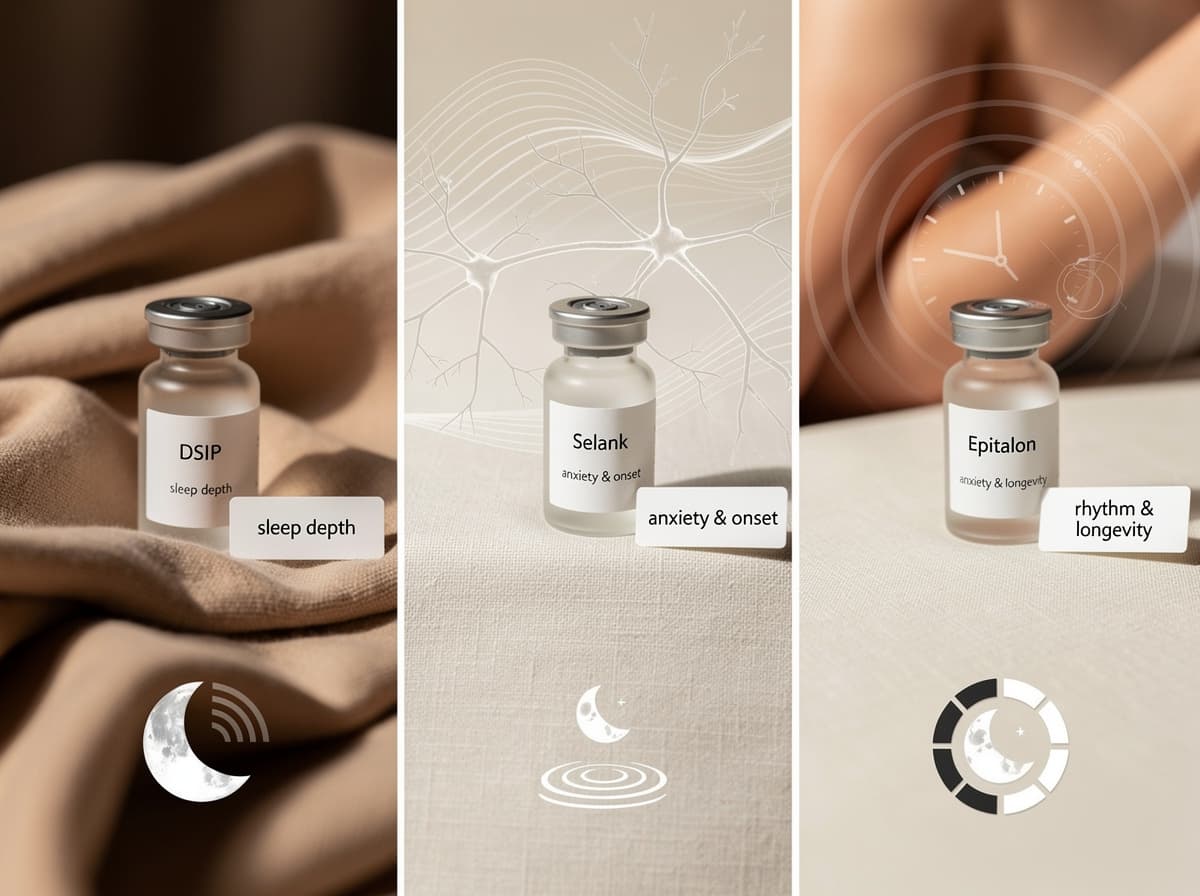
- DSIP is the architecture peptide: research models show it modulates sleep architecture by enhancing delta EEG rhythms and spindle activity , not by sedating.
- Selank is the anxious-wake-up peptide: clinical studies have shown an anxiolytic effect comparable to benzodiazepines , with no dependence reported in short Russian trials.
- Epitalon is the circadian peptide: its parent extract, Epithalamin, has been shown to recover night release of endogenous melatonin and normalise the hormone's circadian rhythm in elderly subjects with pineal insufficiency , and Epitalon is its synthetic analogue.
- Sleep is foundational, not optional. Both total and partial sleep deprivation induce adverse changes in cognitive performance, impairing attention, working memory, long-term memory and decision-making .
- None of these compounds are approved as sleep medications. They sit firmly in research and wellness contexts, and protocols vary by individual.
Why a peptide approach differs from a sleeping pill#
Conventional hypnotics work by depressing the central nervous system. The user falls unconscious. The architecture underneath, the cycling between non-REM and REM, the depth of slow-wave sleep, the cortisol curve, often gets worse rather than better. Tolerance builds. Mornings feel heavy.
Peptides occupy a different lane. DSIP does not appear to sedate; it seems to normalise sleep patterns rather than induce sleep through central nervous system depression . That distinction matters because the goal of a thoughtful sleep protocol is not unconsciousness. It is restoration. The brain has its own sleep machinery; the question is whether that machinery is firing correctly.
Three peptides dominate this conversation in 2026, and each addresses a different failure point. Understanding which failure you have is the entire game.
DSIP: the architecture peptide#
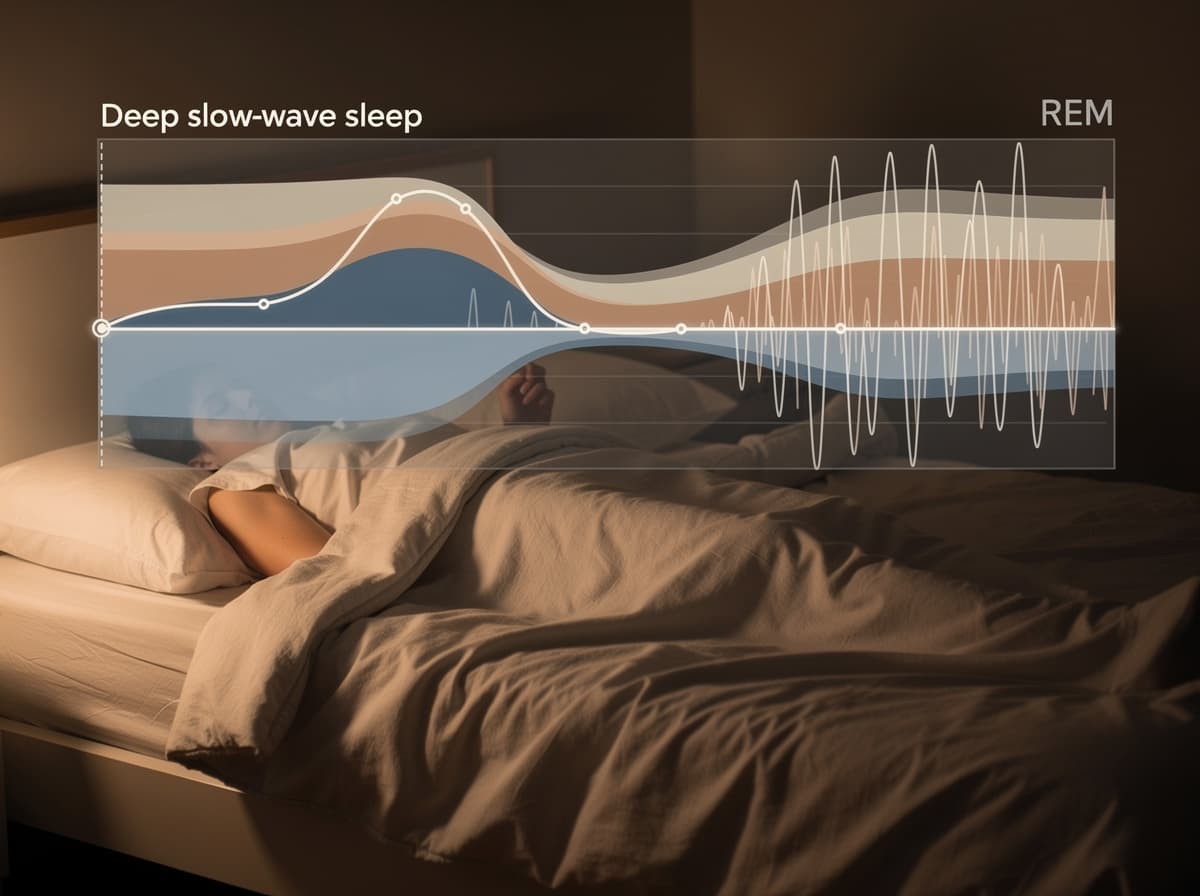
DSIP, or delta sleep-inducing peptide, was first isolated from rabbit cerebral blood in the 1970s. It is a nonapeptide first isolated in the mid-1970s, with the amino acid sequence tryptophan-alanine-glycine-glycine-aspartate-alanine-serine-glycine-glutamate . Its name comes from what researchers observed: an increase in the slow, high-amplitude delta waves that define stage 3 sleep.
What it actually does is more interesting than its name suggests. DSIP does not have a single well-characterised receptor; instead, it appears to influence multiple brain systems involved in sleep regulation and stress, with research exploring effects on cortisol release, neurotransmitter levels including serotonin and GABA, and autonomic nervous system tone . That multi-target profile is why pharmaceutical development around DSIP has been slow, and also why it keeps reappearing in research.
The relevant clinical signal comes from older work. Early clinical research in the 1980s showed that DSIP injections helped some patients with chronic insomnia fall asleep faster and improved sleep architecture . The studies were small and the results not always consistent, but the mechanism, normalising delta activity rather than blunting consciousness, has held up.
DSIP is best matched to the user whose sleep duration looks fine on paper but whose recovery feels broken. Eight hours in bed, four hours of usable rest. That is an architecture problem.
Selank: when the brain will not stop talking#
Selank addresses a different complaint entirely. Some people fall asleep without trouble but wake at 3 AM with their cortisol already firing and their mind running through tomorrow's meeting list. That is not an architecture failure. That is an anxiolytic deficit.
Selank is a synthetic heptapeptide originally developed at the Institute of Molecular Genetics of the Russian Academy of Sciences. It consists of seven amino acids (Thr-Lys-Pro-Arg-Pro-Gly-Pro) derived from the naturally occurring immunoregulatory peptide tuftsin . Its mechanism overlaps with sleep without targeting sleep directly.
The relevant pharmacology: clinical studies have shown that Selank had an anxiolytic effect comparable to that of classical benzodiazepine drugs, which can enhance the inhibitory effect of GABA by allosteric modulation of GABA-A receptors, and the molecular mechanism may be related to its ability to affect the GABAergic system . Unlike benzodiazepines, the effect appears selective. The result, in the published Russian trials, is anxiolysis without reported cognitive blunting or dependence.
This matters for sleep because anxiety and sleep onset are coupled. Selank has a pronounced anxiolytic activity and sustained neuropsychotropic, antidepressant and antistress effects . In rat models of chronic stress, research published in PMC demonstrated that anxiety indicator values after the simultaneous use of diazepam and Selank did not differ from the respective values observed before chronic stress exposure , suggesting complementary action when paired with conventional anxiolytics.
For the late-night ruminator, Selank is the more rational lever than DSIP. It does not put you to sleep. It removes the reason you are awake.
Epitalon: the circadian peptide for melatonin decline#
The third failure mode is the one most people over 40 quietly accumulate. Melatonin output falls with age. The pineal gland calcifies. Sleep gets lighter, more fragmented, less restorative. Exogenous melatonin tablets can patch this short-term; whether years of nightly use affect the gland's own production is not well studied.
Epitalon takes a different route. It is a four-amino-acid peptide with the sequence Ala-Glu-Asp-Gly, created by Russian researchers as a synthetic version of Epithalamin, a natural polypeptide extract derived from bovine pineal glands . Rather than supplying the hormone, it nudges the gland.
The clinical evidence is modest but pointed, and most of it was generated with Epithalamin, the bovine pineal extract, rather than synthetic Epitalon itself. A 2004 study by Korkushko and colleagues gave Epithalamin to elderly subjects whose pineal function had declined with age. The preparation restored nighttime melatonin peaks in subjects whose pineal function had declined with age; in subjects with initially low melatonin, dark-period plasma melatonin concentrations increased significantly, while in those with normal function the effect was modulatory rather than stimulatory, suggesting a normalising rather than simply boosting action .
Preclinical data points to a direct mechanism. Immunohistochemical studies indicated a significant effect of Epitalon on the expression of the pCREB transcription factor and AANAT enzyme in pinealocyte culture, with the peptide's effect on AANAT and pCREB underlying its regulation of pineal cell activity . AANAT is the rate-limiting enzyme in melatonin synthesis, which is the cleanest plausible mechanism for the observed circadian effect.
The honest framing: the sleep benefits commonly reported by users have not been validated in controlled settings, the longevity claims are based on animal studies and small human cohorts, and long-term safety in humans is not established through rigorous clinical trials . Epitalon is interesting, biologically plausible, and undersourced by Western-standard trials.
Stacking logic: why DSIP and Selank crossover works#
The most common protocol question is whether these peptides can be combined. They hit different receptors and different problems, which is the structural condition for a paired effect.
DSIP modulates sleep architecture from the hypothalamic side. Selank modulates GABAergic tone and reduces the arousal that prevents sleep onset. The two do not compete for the same receptor; their effects are complementary. A user who both falls asleep slowly (anxiety) and wakes unrefreshed (architecture) has two failure modes, and addressing only one leaves the other intact.
Epitalon sits on a different timescale entirely. It is typically run in short cycles rather than nightly. Common protocols involve daily injections for 10 to 20 days, repeated two to three times per year, with dosing and cycling determined based on the individual's profile, age and goals . That cadence means it can sit alongside a DSIP or Selank protocol without overlap concerns.
To map a stack to your own profile, the peptide calculator handles the dose arithmetic; the underlying logic of how Klarovel structures protocols is laid out in how it works.
What the underlying research on sleep loss actually shows#
The reason any of this is worth attention is that sleep debt compounds in ways most people underestimate. The intricate relationship between sleep and memory has been a subject of extensive research, revealing that sleep plays a crucial role in both consolidating memories and preparing the brain for new memory formation; sleep deprivation, therefore, has significant adverse effects on memory .
The performance hit is not subtle. According to a review in Neuropsychiatric Disease and Treatment, both total and partial sleep deprivation induce adverse changes in cognitive performance; total sleep deprivation impairs attention and working memory but also affects long-term memory and decision-making, while partial sleep deprivation influences attention, especially vigilance .
And the mechanism is specific. Prior studies suggest that neural activity during slow wave sleep or REM sleep stage is associated with the replay of past experiences, contributing to the consolidation process of memory traces, and sleep deprivation may adversely affect memory consolidation . Slow-wave sleep is exactly what DSIP is associated with modulating. The architecture is the cognition.
This is also why hedge phrases matter. Preliminary evidence is preliminary. Research suggests is not research proves. But the directional signal across these three peptides is consistent: they engage the systems the body already uses to regulate sleep, rather than overriding them.
Compound guides for sleep: DSIP Peptide and Sleep.
Where to go from here#
Sleep is the foundation under every other cognitive and recovery protocol. Optimising it before stacking nootropics, GH peptides, or any performance compound is the rational sequence. The three peptides above are not interchangeable; matching the right one to the right failure mode is the entire point.
If you want to structure a protocol against your actual sleep profile, start with a Klarovel account at /register and run the inputs through the peptide calculator. The molecules are a small part of the work. The protocol is most of it.
Frequently asked questions
Keep reading
Wegovy Pill: How It Works, How to Take It, and Results
The Wegovy pill is semaglutide 25 mg taken daily, FDA-approved for weight loss in December 2025. How to take it, how well it works, and how it compares.
5-Amino-1MQ Guide: What the NNMT Evidence Actually Shows
5-Amino-1MQ is sold for fat loss, but every published result is preclinical. Read the NNMT mechanism, the circulating dosing range, and its FDA status.

Peptides for Men: What Works by Goal and Evidence Stage
Men search peptides for seven goals: muscle, fat loss, libido, hormones, recovery, hair, longevity. Here is the FDA status and trial evidence behind each.