
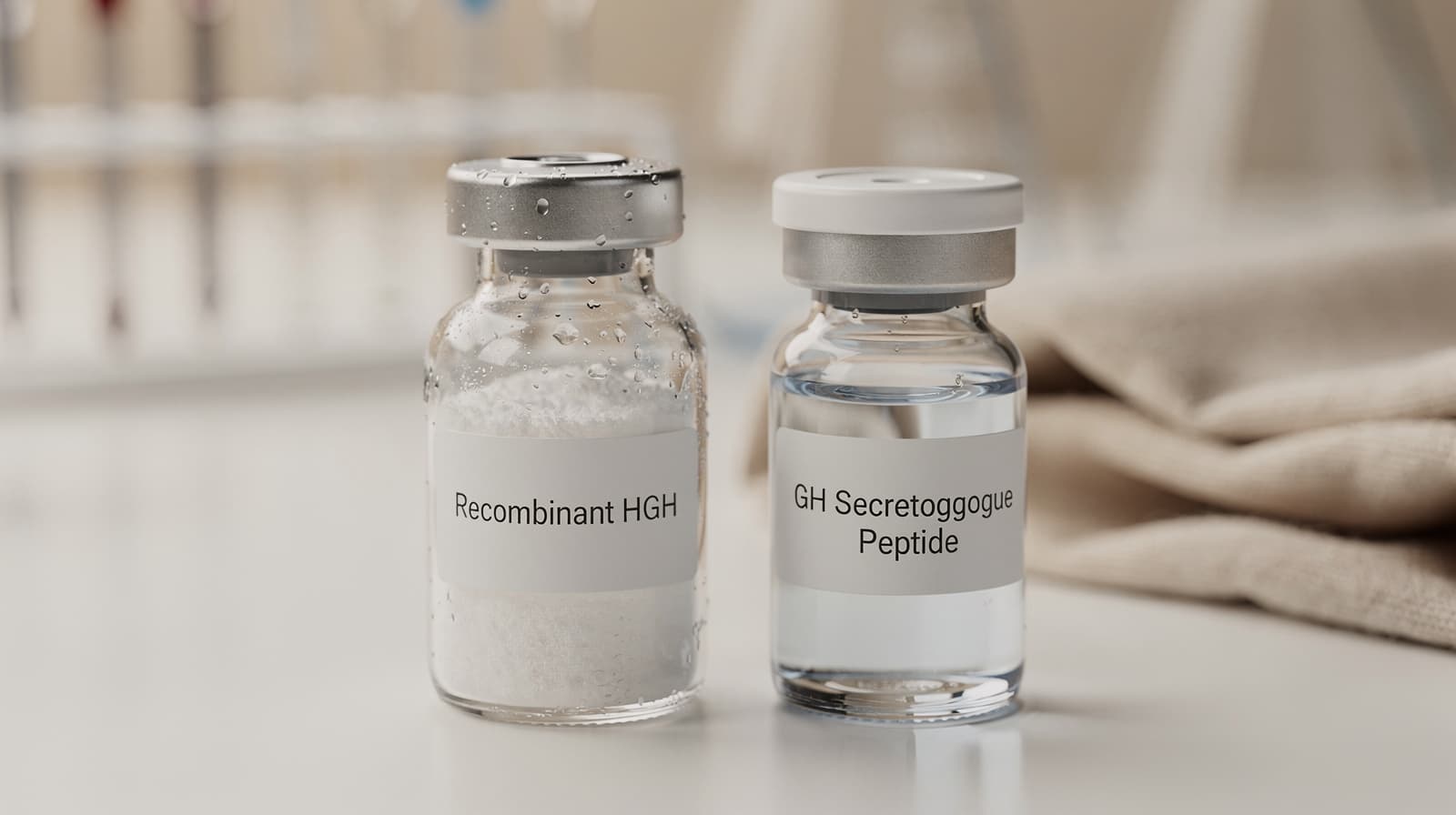
The question almost every reader brings to this comparison is the same: are GH-secretagogue peptides just a cheaper, legal back door to growth hormone? The answer changes depending on whether the lens is pharmacology, evidence quality, or US federal law. This guide separates the three, because the three give different verdicts.
Key takeaways#
- Recombinant HGH (somatropin) supplies the GH molecule directly; GH-secretagogue peptides like ipamorelin, CJC-1295, sermorelin, and tesamorelin signal the pituitary to release its own GH in pulses.
- HGH is a federally restricted prescription biologic. Distributing it for anti-aging, athletic, or off-label cosmetic use is explicitly illegal under 21 USC 333(e), regardless of whether a clinician writes the script.
- Peptides preserve pulsatile GH release and negative feedback; chronic supraphysiological rhGH suppresses endogenous production and is linked to insulin resistance, joint pain, edema, and carpal tunnel symptoms.
- Tesamorelin is the only GHRH analog currently approved and marketed in the US, and only for HIV-associated abdominal fat. Sermorelin was approved as Geref until its maker discontinued it in 2008; most other GH-axis peptides are research compounds with no licensed clinical indication.
- For genuine adult growth hormone deficiency confirmed by stimulation testing, rhGH is the evidence-based answer. For everyone else, the peptide route carries lower regulatory and metabolic exposure, but the outcome evidence is thinner.
How recombinant HGH works#
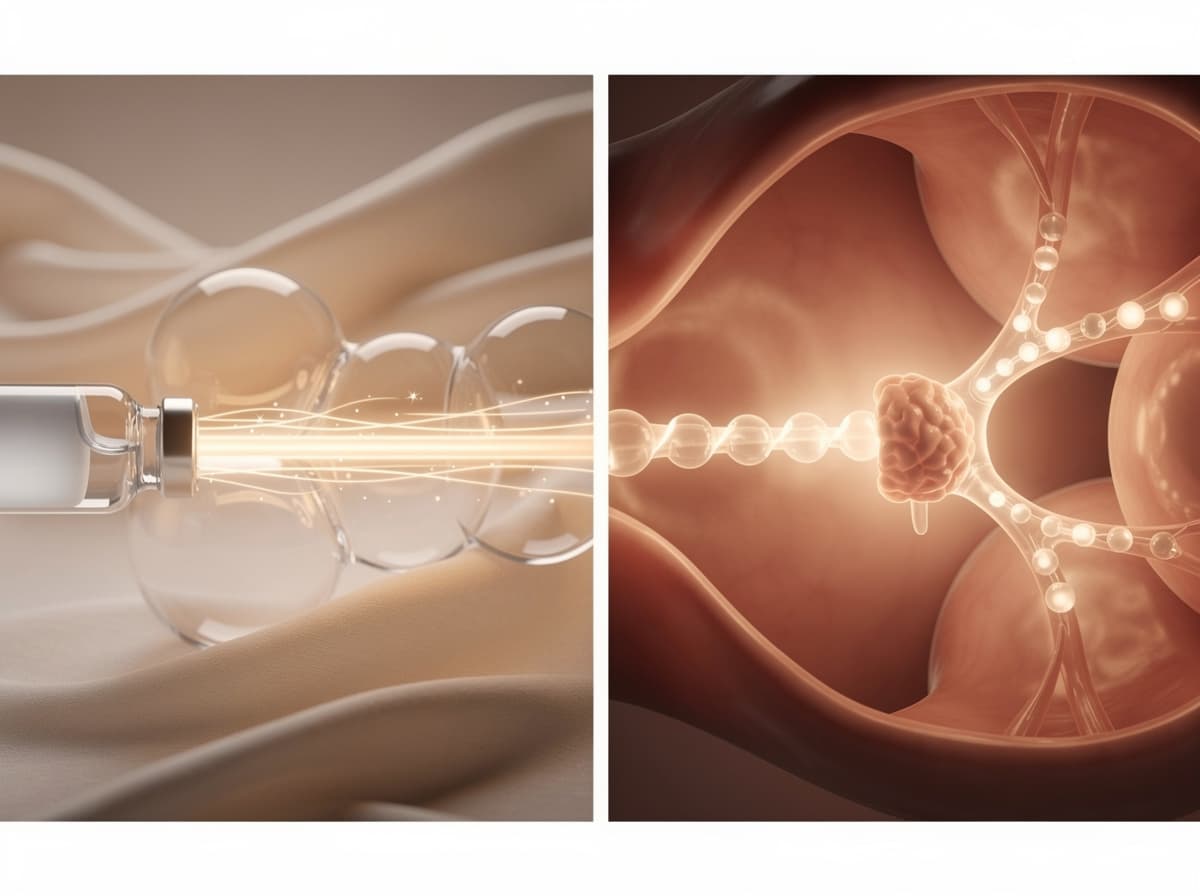
Recombinant human growth hormone is somatropin: a 191-amino-acid protein manufactured to be nearly identical to pituitary-derived GH. Scientists use recombinant DNA technology to produce rhGH by inserting the human growth hormone gene into E. coli bacteria, creating a pure, consistent hormone that is usually administered via subcutaneous injection. Once injected, it bypasses the hypothalamic-pituitary axis entirely and binds GH receptors directly across tissue, signaling the liver to produce IGF-1, the main downstream mediator of anabolism and lipolysis.
The pharmacological cost of that directness is feedback suppression. Continuous supraphysiological GH levels eliminate the natural pulsatility the somatotroph axis is built around, and chronic exposure produces a recognizable adverse-event profile. Carpal tunnel compression, arthralgias, and fluid retention are reported as common complaints in controlled studies, and chronic administration has been shown to drive insulin resistance and suppress endogenous GH production. The mechanism for the metabolic effect is well characterized: growth hormone promotes lipolysis, which has been shown to be the principal determinant of its insulin-antagonistic properties . Acromegaly, the disease state of chronic GH excess, is the cautionary endpoint. Acromegaly is characterized by chronic overproduction of growth hormone that leads to insulin resistance, glucose intolerance and, ultimately, diabetes.
How GH-secretagogue peptides work#
Secretagogue peptides do not contain GH. They act one step upstream, at the pituitary, recruiting the body's own GH-producing cells. There are two receptor families involved.
GHRH analogs, including sermorelin, CJC-1295, and tesamorelin, bind the GHRH receptor on somatotrophs and amplify the natural GHRH signal. Ghrelin-receptor agonists, the GHRPs, include ipamorelin, hexarelin, GHRP-2, GHRP-6, and the oral non-peptide MK-677. Ipamorelin is one of the mildest and most selective growth hormone releasing peptides; it stimulates GH release through the ghrelin receptor without significantly affecting cortisol or prolactin levels.
Critically, the pulsatile architecture is preserved. In a healthy-volunteer study of CJC-1295, research has shown that CJC-1295 increased trough and mean GH secretion and IGF-I production with preserved GH pulsatility, and the marked enhancement of trough GH levels by continuous GHRH stimulation implicates the importance of this effect on increasing IGF-I . That is the structural difference the comparison turns on: peptides amplify a system that still answers to somatostatin and negative feedback. rhGH does not.
Dosing: peptides vs HGH#
Research protocols typically range from microgram-scale, frequent peptide doses to milligram-scale, less frequent rhGH doses. Specifics depend heavily on the compound, the indication, and whether the user is in a deficiency state or a healthy baseline.
For rhGH, adult deficiency replacement is titrated to IGF-1 level rather than weight. In the HIV-rhGH trial published in PLOS ONE, participants received rhGH 3 mg daily for 12 weeks for visceral fat reduction. The newer once-weekly long-acting somatropin prodrug, lonapegsomatropin, was approved by the FDA in July 2025 for adult GHD on the basis of the phase 3 foresiGHt trial.
For secretagogue peptides, research-published protocols cluster around microgram doses. Ipamorelin research protocols typically use 100 to 300 mcg two to three times daily subcutaneously, with a half-life around 2 hours. CJC-1295 without DAC is dosed similarly because its short half-life matches ipamorelin's pulse window. CJC-1295 with DAC is structurally different: a synthetic GHRH analog (CJC-1295) that binds permanently to endogenous albumin after injection (half-life = 8 d) stimulates GH and IGF-I secretion in several animal species and in normal human subjects , which translates to weekly or biweekly research dosing rather than daily. Tesamorelin in its FDA-approved indication is dosed at 1.4 mg (Egrifta SV) or 1.28 mg (Egrifta WR) subcutaneously once daily; the original Egrifta and its pivotal trials used 2 mg.
Timing matters more for peptides than for rhGH. Research literature consistently recommends fasted, pre-bed administration for ghrelin-axis secretagogues because elevated insulin and free fatty acids blunt the GH response. rhGH bypasses that constraint because it does not require pituitary cooperation.
Evidence: what the studies actually show#
There is no head-to-head randomized trial of GH-secretagogue peptides against recombinant HGH in healthy adults. The comparison is built from parallel evidence bases of very different quality.
On the rhGH side, the strongest signal against casual anti-aging use comes from the Liu et al. systematic review in the Annals of Internal Medicine. The review pooled 18 randomized trials of rhGH in healthy elderly subjects and concluded that the literature suggests that it is associated with small changes in body composition and increased rates of adverse events . The same group's 2008 review on athletic performance found higher proportions of soft tissue edema, joint pain, and carpal tunnel syndrome in participants receiving growth hormone .
On the peptide side, the strongest single human dataset is the tesamorelin phase 3 program. Across two large phase III trials enrolling 806 patients, tesamorelin was shown to selectively reduce visceral fat by approximately 15% over 26 weeks and 18% over 52 weeks with no change in subcutaneous fat or BMI compared to placebo . Trial by trial, the 26-week figure was 15.2% in the first phase 3 trial (Falutz et al. 2007) and 10.9% in the second (Falutz et al. 2010). For CJC-1295, the Teichman 2006 trial in JCEM found that after a single injection of CJC-1295, there were dose-dependent increases in mean plasma GH concentrations by 2- to 10-fold for 6 d or more and in mean plasma IGF-I concentrations by 1.5- to 3-fold for 9-11 d . For ipamorelin, sermorelin, and the ghrelin-receptor agonists more broadly, large randomized controlled trials on outcomes like body composition or recovery in healthy adults are essentially absent. Preliminary evidence is hypothesis-generating, not definitive.
The honest summary: rhGH has more outcome data, and most of that data is in deficiency states. Peptides have cleaner mechanistic data and one cleanly approved indication (tesamorelin for HIV lipodystrophy). The rest is preclinical or early-phase.

Side effects and contraindication profile#
The two categories diverge sharply here, and the divergence is mechanistic rather than incidental.
Recombinant HGH at supraphysiological doses produces the predictable cluster: fluid retention, peripheral edema, arthralgias, carpal tunnel symptoms, fasting glucose elevation, and worsened insulin sensitivity. The HIV-rhGH trial documented that recombinant human growth hormone reduces visceral adipose tissue volume in HIV-infected patients but can worsen glucose homeostasis and lipoatrophy . The mechanism is intrinsic: GH is counter-regulatory to insulin. Long-term oncological signal is theoretical but flagged in every label.
GH-secretagogue peptides share a milder version of the same downstream profile because they also elevate GH and IGF-1, but with two structural differences. First, pulsatility is preserved, so trough exposure is lower. Second, somatostatin negative feedback still applies, capping the ceiling effect. In practice, research-use reports describe injection-site reactions, transient headache during initiation, mild water retention, and occasional paresthesia as the most common findings. Tesamorelin's FDA label specifies arthralgia, injection site reactions, pain in extremity, peripheral edema, and myalgia as the most common adverse reactions, mirroring the GH-axis class. The non-selective GHRPs (hexarelin, GHRP-2, GHRP-6) additionally raise cortisol and prolactin; ipamorelin and the GHRH analogs largely do not.
Contraindications overlap: active malignancy, pregnancy, active proliferative diabetic retinopathy, and any clinical setting where IGF-1 elevation is undesirable.
When to choose recombinant HGH#
There is a narrow set of scenarios where rhGH is the right tool and peptides are not:
- Confirmed adult growth hormone deficiency, established by insulin tolerance test, glucagon stimulation test, or macimorelin stimulation, with low IGF-1 and a structural pituitary cause (tumor, surgery, radiation).
- Pediatric GHD, Turner syndrome, Prader-Willi syndrome, Noonan syndrome, idiopathic short stature, or small-for-gestational-age failure to catch up, all listed on the current Norditropin (somatropin) label. Other somatropin brands add SHOX deficiency or growth failure from chronic kidney disease; each brand's label carries its own subset.
- HIV-associated AIDS wasting syndrome where lean mass preservation is the clinical priority.
In every one of these, the patient has documented pathological GH deficiency or a labeled indication, and replacement is the point.
When to choose secretagogue peptides#
Peptides are the more rational starting point when the user is not in a labeled deficiency state but the GH axis is the target:
- Age-related GH decline with low-normal IGF-1, intact pituitary, no structural lesion.
- Visceral adiposity as a metabolic-syndrome driver, where tesamorelin has the strongest evidence and the cleanest regulatory status.
- Sleep and recovery research in healthy adults, where amplification of the natural nocturnal GH pulse with a short-acting CJC-1295 plus ipamorelin protocol is the established preclinical framing.
- Any context where preserving endogenous pulsatile secretion and somatostatin feedback is a design requirement of the protocol.
- Cost is a constraint (peptides are typically an order of magnitude cheaper per cycle). The regulatory picture is not simpler, only different: tesamorelin is an approved drug that can be prescribed off-label, sermorelin is compounded by 503A pharmacies on prescription, while CJC-1295 cannot be compounded after a 0 to 13 FDA advisory committee vote in December 2024 (FDA minutes) and ipamorelin sits in Category 2 for outsourcing facilities.
Can you stack them?#
Stacking rhGH with a GH-secretagogue is not standard practice and the mechanistic conflict is direct: exogenous GH triggers somatostatin release, which is the brake on pituitary GH output. Adding a secretagogue on top of suppressive rhGH exposure is pharmacologically incoherent because the somatotroph is being told to release while the negative-feedback signal is telling it to stop.
What is widely documented is stacking two peptides with complementary mechanisms. A GHRH analog (CJC-1295 without DAC) plus a ghrelin-receptor agonist (ipamorelin) hits two different receptors on the same somatotroph. Research literature describes this combination producing supra-additive GH release because the two pathways converge on cAMP and calcium signaling at the pituitary level. That is the canonical "GH peptide stack" and it does not require rhGH to be in the picture.
Verdict#
For confirmed adult or pediatric growth hormone deficiency, recombinant HGH is the evidence-based answer and the peptide route is not equivalent. For everyone else, secretagogue peptides are the better starting point because they preserve pulsatility and negative feedback, carry a milder adverse-event profile, and sit in a less hostile regulatory zone. The decisive variable is not strength. rhGH is stronger. The decisive variable is regulatory exposure and the matching of pharmacology to a real clinical question. Most readers asking "is this just expensive HGH?" are not in a deficiency state, which means rhGH is both legally restricted and pharmacologically the wrong shape for what they actually want.
The honest one-sentence version: HGH replaces a signal the body should be making; peptides ask the body to make it. If the body still can, peptides are the more rational instrument. If the body cannot, peptides will not rescue it, and rhGH under endocrinologist supervision is the real intervention.
Decide with data, not marketing#
Klarovel sits at the protocol layer and the decision rule; it does not sell, source, or fulfil peptides. If the question driving you to this page is "should I be on HGH or on a peptide stack?", the honest answer is that it depends on your health history, your goal, and, if you have them, your IGF-1, fasting glucose, and stimulation-test result. Run the numbers in the peptide calculator, complete the questionnaire so the protocol gets built around your health profile rather than around a YouTube thumbnail, and read the how-it-works page to see how the curation works. If the difference between replacing the signal and recruiting it still feels fuzzy, the GH axis explained covers how the pituitary, GHRH, and ghrelin pathways actually fit together. The peptide-vs-HGH question gets a real answer once your health profile is the input, not your intuition.
Frequently asked questions
Keep reading
Peptides for Inflammation: Mapping BPC-157, KPV, and Thymosins
Peptides for inflammation compared by mechanism and evidence stage: BPC-157, KPV, thymosin alpha-1, and thymosin beta-4, with FDA status and safety notes.
Mounjaro vs Zepbound: Same Drug, Two Different FDA Labels
Mounjaro and Zepbound are the same drug, tirzepatide, at the same doses. The difference is the FDA label: diabetes for Mounjaro, weight loss for Zepbound.
Rybelsus for Weight Loss: Not Approved, and the Pill That Is
Rybelsus is not FDA-approved for weight loss and moves the scale only a little. The oral semaglutide approved for weight loss is the Wegovy pill at 25 mg.