
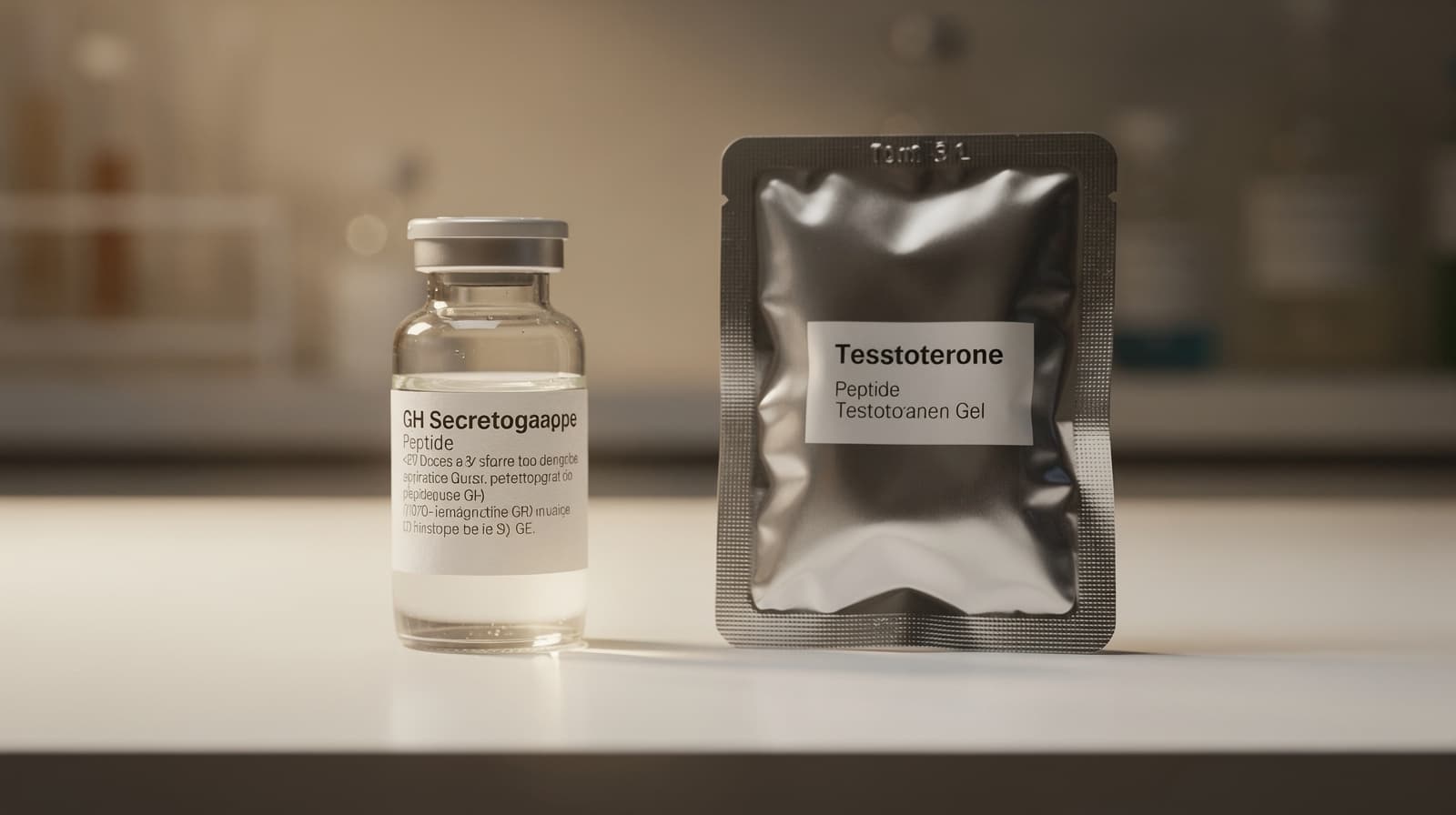
The choice between GH-secretagogue peptides and testosterone replacement therapy is rarely about which compound is "stronger." It is about which axis is actually broken. This comparison breaks down the mechanism, evidence, dosing reality, and side-effect profile of both, then gives a decision rule.
Key takeaways#
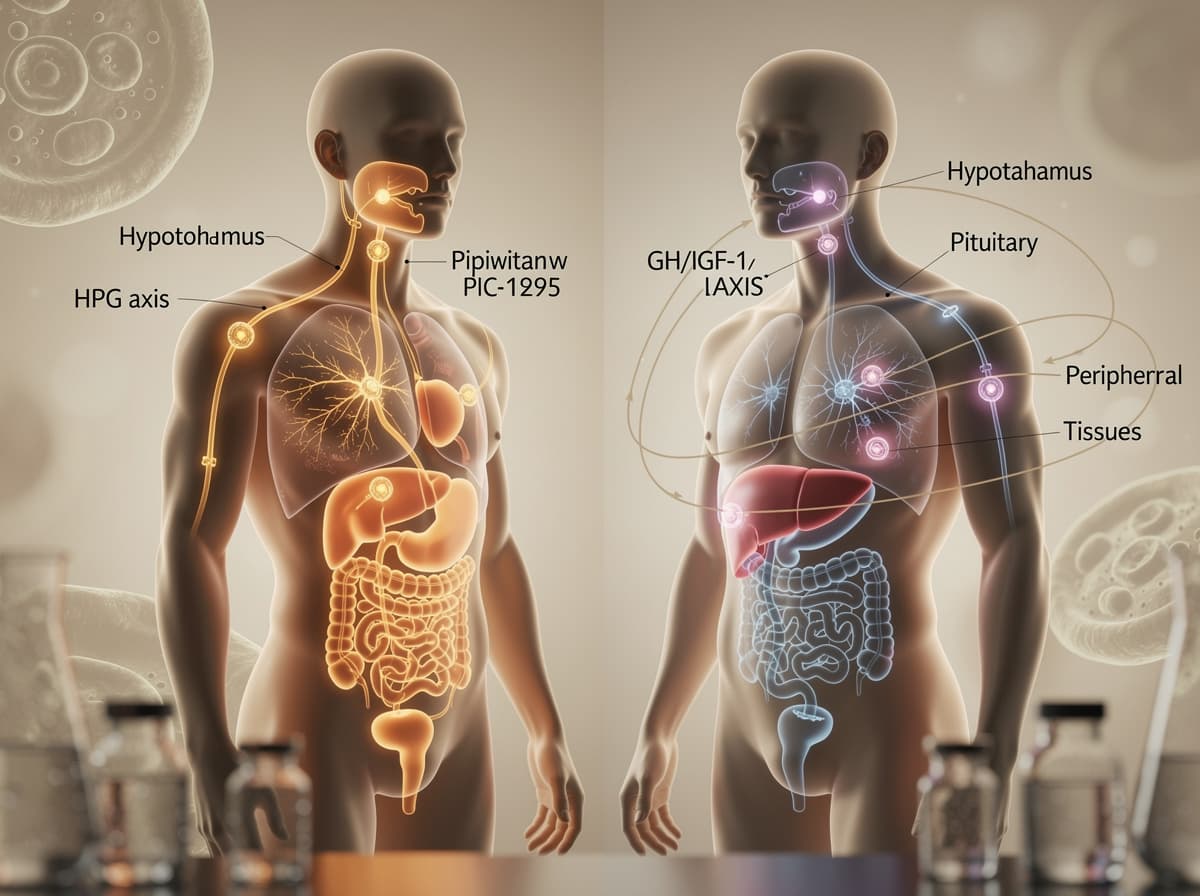
- Peptides like CJC-1295 and ipamorelin act on the GH/IGF-1 axis; TRT acts on the HPG (testosterone) axis. They are not interchangeable.
- TRT has decades of human outcome data including the 5,246-man TRAVERSE cardiovascular trial; GH-secretagogue stacks have far smaller, mostly preclinical and early-phase human datasets.
- TRT typically suppresses endogenous testosterone production and fertility within months; GH secretagogues preserve pulsatile feedback and do not suppress the HPG axis.
- For diagnosed hypogonadism with symptoms, TRT is the standard of care. For body composition, recovery, and sleep quality in eugonadal adults, GH-secretagogue research is the more proportionate starting point.
- Stacking the two is biologically possible because the axes are independent, but it doubles monitoring complexity and is not a standard research protocol.
How peptides work in this comparison#
The "peptides" side of this match-up usually means GH secretagogues, most often a CJC-1295 plus ipamorelin pairing, sometimes tesamorelin. These compounds do not deliver growth hormone. They prompt the pituitary to release its own. CJC-1295 is a synthetic GHRH analogue that binds the GHRH receptor on anterior pituitary somatotrophs, activating Gs-protein signalling and cAMP-driven GH gene expression. Ipamorelin is a pentapeptide that hits a different target: the growth hormone secretagogue receptor type 1a, the ghrelin receptor on the same somatotroph cells, triggering calcium-dependent GH release.
The two pathways are independent, which is why the pair shows complementary action in mechanistic work. Co-administration of a GHRH analogue and a GHRP-class peptide produces a larger GH release than either alone, an effect described in human studies since the 1990s, though no published trial has measured it for the specific CJC-1295 plus ipamorelin pairing. Ipamorelin is selective: at GH-releasing doses it produces little cortisol or prolactin co-stimulation in early pharmacology work, which is the main reason it displaced GHRP-2 and GHRP-6 in modern protocols. Tesamorelin is a separate animal: a stabilised GHRH analogue with FDA approval for HIV-associated lipodystrophy, giving it the most rigorous human safety dataset of any GH-secretagogue peptide.
The shared feature: these compounds preserve the natural pulsatile pattern of GH release and remain subject to negative feedback from IGF-1. They do not flatten the axis.
Regulatory status differs sharply. Tesamorelin is an FDA-approved prescription drug. CJC-1295 and ipamorelin are not FDA-approved for any use, and neither can currently be compounded under 503A: an FDA advisory committee voted 0 to 13 against listing CJC-1295 in December 2024, and ipamorelin is on neither the 503A bulks list nor Category 1, while remaining in Category 2 for 503B outsourcing facilities (FDA Category 2 list).
How TRT works in this comparison#
Testosterone replacement therapy substitutes exogenous testosterone for what the testes are no longer producing in adequate amounts. The target diagnosis is hypogonadism, and the AUA guideline uses a total testosterone below 300 ng/dL on two separate early-morning measurements, alongside symptoms, before initiation (TRAVERSE required two fasting morning values below 300 ng/dL). Routes include transdermal gels, intramuscular or subcutaneous injections of testosterone cypionate or enanthate, long-acting undecanoate injections, subcutaneous pellets, and oral undecanoate. Each route produces a different pharmacokinetic curve and a different side-effect emphasis.
Mechanistically, exogenous testosterone binds androgen receptors throughout the body and aromatises to estradiol at variable rates depending on body composition. The clinical effects, restored libido, improved erectile function, increased lean mass, reduced visceral fat, better mood, are well documented in hypogonadal men. The trade-off is that exogenous testosterone suppresses the hypothalamic-pituitary-gonadal axis. LH and FSH drop, intratesticular testosterone falls, and spermatogenesis is impaired in most men on monotherapy TRT, with azoospermia reported in about 40%. This is the central biological difference from the peptide side.
Dosing: peptides vs TRT#
Research-published dose ranges differ in unit, frequency, and pharmacokinetic philosophy.
For the GH-secretagogue side, research protocols typically pair CJC-1295 (no-DAC) at roughly 100 mcg with ipamorelin at 100 to 300 mcg, administered subcutaneously once to three times daily, often timed pre-bed to align with the natural overnight GH pulse. Tesamorelin's FDA-approved dose for HIV-associated lipodystrophy is 1.28 mg subcutaneously once daily for EGRIFTA WR or 1.4 mg once daily for EGRIFTA SV (the two are not interchangeable); the original EGRIFTA formulation and the pivotal trials used 2 mg. CJC-1295 with DAC sits outside this profile because its multi-day half-life flattens the pulse pattern.
For TRT, the TRAVERSE trial used daily transdermal 1.62% testosterone gel, dose-adjusted to maintain testosterone levels between 350 and 750 ng/dL. Injectable testosterone cypionate is commonly published in 100 to 200 mg per week, split into two doses to flatten peaks and troughs. Subcutaneous testosterone pellets are dosed at 150 mg to 450 mg every 3 to 6 months. Oral testosterone undecanoate (TLANDO) was studied at 225 mg twice daily with a meal.
The cadence difference matters. Peptide protocols demand near-daily compliance and timing discipline. TRT, especially pellets or long-acting injectables, can run on weekly or quarterly intervals. That practical asymmetry shapes adherence and lifestyle fit.
Evidence: what the studies actually show#
The evidence bases are not comparable in scale.
TRT has the TRAVERSE trial, a randomised, double-blind, placebo-controlled study that randomised 5,246 hypogonadal men aged 45 to 80 with established or high-risk cardiovascular disease (5,204 in the full-analysis population). Over a mean follow-up of 33 months, testosterone therapy was non-inferior to placebo on the primary composite endpoint of cardiovascular death, non-fatal MI, and non-fatal stroke (7.0% vs 7.3%; hazard ratio 0.96). In response, on February 28, 2025 the FDA announced class-wide labeling changes: adding the TRAVERSE results, removing language from the Boxed Warning about an increased risk of adverse cardiovascular outcomes, keeping the Limitation of Use for age-related hypogonadism, and adding a blood pressure warning to every testosterone product after ambulatory monitoring studies confirmed a class-wide increase. Studies have shown clear improvements in sexual function, anemia, bone density, and body composition in hypogonadal men, though TRAVERSE did flag specific secondary signals worth taking seriously.
The peptide side is thinner. Tesamorelin's lipodystrophy trials are the strongest data point: studies have shown that tesamorelin reduces visceral adipose tissue by approximately 15 to 18% versus placebo over 26 weeks in HIV-associated lipodystrophy. For CJC-1295 and ipamorelin individually, preliminary evidence includes small healthy-adult pharmacokinetic studies showing sustained GH and IGF-1 elevation with CJC-1295 in healthy adults, and ipamorelin's selectivity profile is documented in early human pharmacology work. Research suggests the combination is mechanistically sound, but no large outcome trial of the CJC-1295 plus ipamorelin stack on body composition, sleep, or recovery in healthy adults exists.
This evidence gap is the most honest single fact in the peptides vs TRT comparison.

Side effects and contraindication profile#
The peptide side is associated with water retention, transient injection-site reactions, tingling or numbness from elevated GH or IGF-1, mild blood-glucose elevation (GH is counter-regulatory to insulin), and rare immunogenicity. FDA's Category 2 review named immunogenicity risk from aggregation and peptide-related impurities for both ipamorelin and CJC-1295, and listed reported serious adverse events for CJC-1295 including increased heart rate and a systemic vasodilatory reaction. The most important hard contraindication is active or recent malignancy, because GH and IGF-1 promote cell proliferation. Insulin resistance and pre-diabetes warrant tighter glucose monitoring.
TRT's signature risks are well-characterised. Erythrocytosis (rising hematocrit) is the most common dose-related adverse effect and requires periodic monitoring. The TRAVERSE results, while reassuring on the primary endpoint, flagged a higher incidence of non-fatal arrhythmias warranting intervention (5.2% vs 3.3%), atrial fibrillation (3.5% vs 2.4%), acute kidney injury and pulmonary embolism (0.9% vs 0.5%) in the testosterone group (Lincoff et al., NEJM 2023), and a fracture substudy found more clinical fractures with testosterone (3.5% vs 2.5%; Snyder et al., NEJM 2024). Suppression of spermatogenesis is the expected outcome for men on monotherapy TRT, and the AUA guideline says testosterone should not be prescribed to men currently trying to conceive; men wanting fertility within 12 months typically pair TRT with hCG or avoid TRT entirely in favour of clomiphene or enclomiphene. Prostate monitoring is standard, and current Endocrine Society guidance recommends urological consultation if PSA rises during the first 12 months.
Overlap zone: both can affect glucose handling and both demand baseline plus follow-up bloodwork. Divergence zone: only TRT suppresses the HPG axis, and only TRT carries the documented hematocrit and VTE signals at clinically relevant frequencies.
When to choose peptides#
Choose the GH-secretagogue route when:
- Bloodwork shows testosterone in the normal range but body composition, sleep depth, or recovery are the actual complaints.
- Fertility preservation is a hard requirement in the next 12 to 24 months.
- The goal is research-context exploration of GH-axis effects rather than substitution for a deficient hormone.
- Visceral adiposity is the dominant issue and tesamorelin's specific profile maps to the complaint (its strongest evidence is from phase 3 trials in HIV-associated lipodystrophy; the extension to general visceral fat reduction is mechanistic, not trial-tested).
When to choose TRT#
Choose testosterone replacement when:
- Two morning fasting testosterone readings are below 300 ng/dL (or 10.4 nmol/L) and symptoms of hypogonadism are present, low libido, erectile dysfunction, fatigue, mood changes, loss of lean mass.
- Hypogonadism is confirmed and fertility is not a near-term goal, or fertility-preserving co-therapy is on the table.
- The bone density, anemia, or sexual function dimensions are dominant; these are the domains where TRT has been shown to produce reliable, replicable effects.
- The patient profile matches the TRAVERSE inclusion criteria (middle-aged or older with documented hypogonadism), because that is where the cardiovascular safety data is strongest.
Can you stack peptides and TRT?#
Mechanistically, yes. The GH/IGF-1 and HPG axes are independent endocrine systems and the receptor targets do not overlap. In practice, stacking is uncommon in research literature because it compounds monitoring complexity: hematocrit, PSA, estradiol, IGF-1, fasting glucose, and lipid panels all become moving targets simultaneously. There is no head-to-head trial of TRT plus GH-secretagogue versus TRT alone in healthy or hypogonadal adults. Stacking is not standard practice because the marginal benefit is undocumented while the monitoring burden roughly doubles.
Verdict#
For confirmed hypogonadism with symptoms, TRT is the better starting point. It has a 5,246-man cardiovascular safety trial behind it, a defined diagnostic threshold, and decades of body-composition and sexual-function data. The peptide side cannot match that evidence base in 2026.
For eugonadal adults whose complaint is sleep quality, recovery, body composition, or visceral fat (and whose testosterone is genuinely in range), a CJC-1295 plus ipamorelin protocol, or tesamorelin where visceral fat is dominant, is the more proportionate intervention. Pushing testosterone above the physiological range to chase those same outcomes is the wrong tool. The decisive variable is the bloodwork, not the marketing.
Make the comparison personal, not generic#
Peptides vs TRT is the wrong question phrased at the right altitude. The right question is which axis your bloodwork actually flags, and which intervention has the evidence base to match the complaint. Quantify your own numbers with the peptide calculator, work through the Klarovel questionnaire to translate symptoms into a research direction, and read how Klarovel curates protocols before deciding which side of this comparison maps to you.
Frequently asked questions
Keep reading
Peptides for Inflammation: Mapping BPC-157, KPV, and Thymosins
Peptides for inflammation compared by mechanism and evidence stage: BPC-157, KPV, thymosin alpha-1, and thymosin beta-4, with FDA status and safety notes.
Mounjaro vs Zepbound: Same Drug, Two Different FDA Labels
Mounjaro and Zepbound are the same drug, tirzepatide, at the same doses. The difference is the FDA label: diabetes for Mounjaro, weight loss for Zepbound.

Rybelsus for Weight Loss: Not Approved, and the Pill That Is
Rybelsus is not FDA-approved for weight loss and moves the scale only a little. The oral semaglutide approved for weight loss is the Wegovy pill at 25 mg.