

Tirzepatide produces roughly twice the weight loss of cagrilintide on its own: 20.9% at 15 mg over 72 weeks in SURMOUNT-1, against 11.5% for cagrilintide 2.4 mg over 68 weeks in REDEFINE 1, both counting everyone randomized. Tirzepatide is FDA-approved; cagrilintide is not, and its main route to market is CagriSema, its fixed-dose pairing with semaglutide, which Novo Nordisk filed with the FDA in December 2025. One amplifies the satiety hormone amylin. The other co-activates two incretin receptors at the same time. This piece compares the two across separate trials, plus the two trials that pitted CagriSema directly against tirzepatide.
Key takeaways#
- Cagrilintide is a long-acting amylin analog with a plasma half-life of roughly 7 to 8 days, supporting once-weekly subcutaneous administration.
- Tirzepatide is a single peptide that activates both the GIP and GLP-1 receptors, also dosed once weekly.
- In the phase 3 REDEFINE 1 trial, cagrilintide 2.4 mg monotherapy produced 11.5% mean weight loss at 68 weeks; in SURMOUNT-1, tirzepatide 15 mg produced 20.9% mean weight loss at 72 weeks (both treatment-policy estimands).
- In the open-label REDEFINE 4 trial, CagriSema 2.4/2.4 mg did not meet non-inferiority against tirzepatide 15 mg at 84 weeks (20.2% versus 23.6%, treatment-regimen estimand).
- Both peptides carry a primarily gastrointestinal side-effect profile, with nausea concentrated in the dose-escalation window.
- Tirzepatide is the stronger monotherapy for absolute weight reduction; cagrilintide's role is increasingly as a complement to GLP-1 pharmacology, not a head-to-head replacement.
How cagrilintide works#
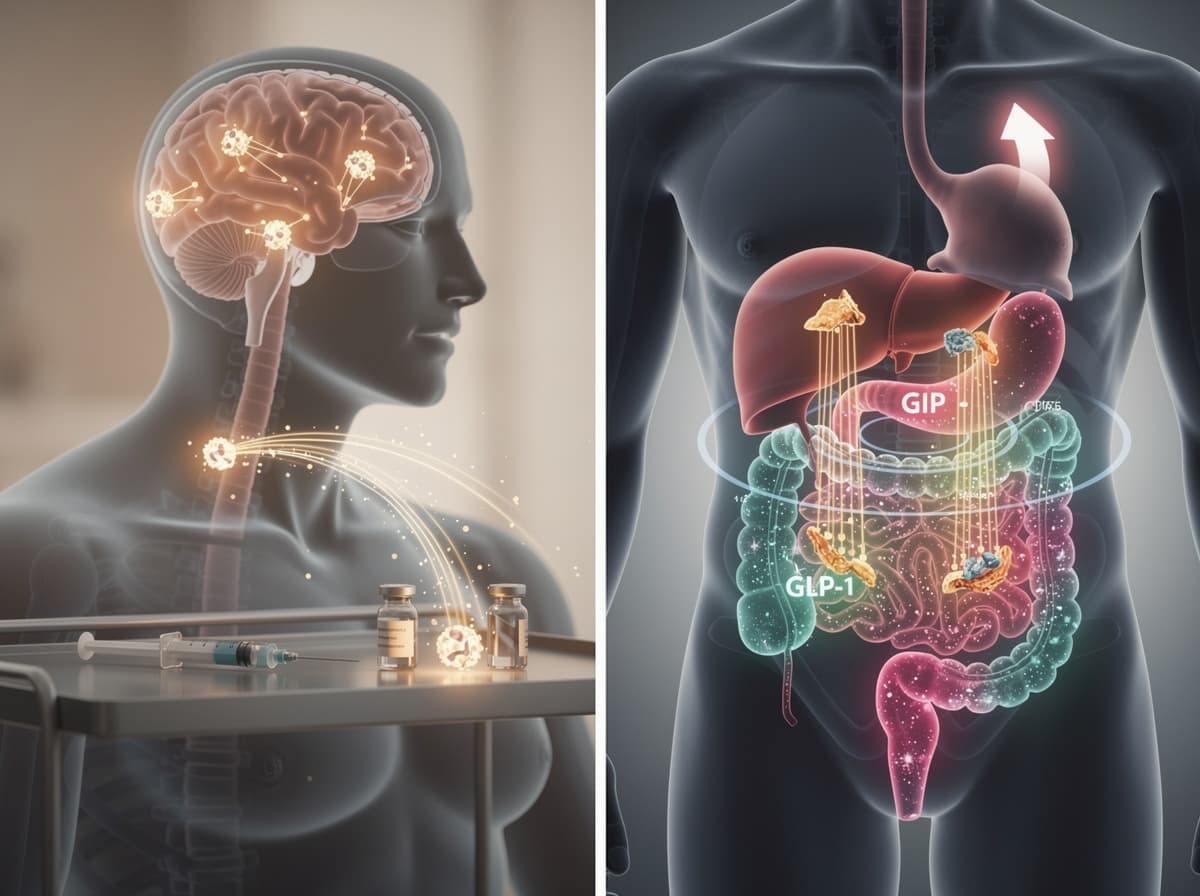
Cagrilintide is a long-acting acylated analog of amylin, the hormone co-secreted with insulin from pancreatic beta cells. Native amylin signals satiety, slows gastric emptying, and suppresses postprandial glucagon. Cagrilintide acts on central amylin receptors, particularly in the area postrema and hindbrain, to reduce appetite and energy intake. Lipid modifications extend its half-life to approximately 159-195 hours, enabling once-weekly subcutaneous dosing.
Mechanistically, cagrilintide is a non-selective agonist at the calcitonin receptor and the amylin 1 and amylin 3 receptors. Preclinical work in knockout mice has confirmed that cagrilintide requires AMY1R and AMY3R to induce weight loss, anchoring the satiety effect specifically to brain amylin signaling rather than a generalized appetite blockade. Research suggests this pathway is largely independent of incretin biology, which is why cagrilintide is being developed both as monotherapy and as a complement to GLP-1 agonists.
How tirzepatide works#
Tirzepatide is a single peptide that activates the body's receptors for two natural incretin hormones, GIP and GLP-1. GIP has been shown to decrease food intake and increase energy expenditure in preclinical models, and when paired with GLP-1 receptor agonism the combined response acts on body weight, glucose, and lipid markers simultaneously. The peptide is administered once weekly by subcutaneous injection.
Functionally, the GLP-1 arm slows gastric emptying and amplifies central satiety circuits, while the GIP arm appears to modulate nutrient handling and energy expenditure. The dual-receptor design is why tirzepatide produces stronger satiety signaling than GLP-1 alone, and it explains the larger absolute weight reductions observed in head-to-head trials against semaglutide.
Dosing: cagrilintide vs tirzepatide#
Research-published dose ranges differ by an order of magnitude in milligram terms, which is a function of receptor affinity rather than potency-per-microgram.
For cagrilintide, the maximum monotherapy dose studied is 4.5 mg weekly, in the phase 2 dose-finding trial, with 2.4 mg weekly used in phase 3 and when combined with semaglutide. Phase 3 protocols escalate every 4 weeks from 0.25 mg through 0.5 mg, 1.0 mg, and 1.7 mg, reaching the 2.4 mg maintenance dose at week 16. Injections are once weekly on the same day each week.
For tirzepatide, the published SURMOUNT trial doses are 5 mg, 10 mg, and 15 mg once weekly, reached through a 20-week dose-escalation period. Research protocols typically begin at 2.5 mg weekly for four weeks to build gastrointestinal tolerance before escalating.
Evidence: what the studies actually show#
There is no published head-to-head randomized trial of cagrilintide monotherapy versus tirzepatide monotherapy. The fair comparison is the strongest phase 3 endpoint from each program, on the same estimand.
For cagrilintide, the REDEFINE 1 phase 3 trial enrolled adults with obesity, or overweight with at least one weight-related complication, and randomized them to once-weekly cagrilintide, semaglutide, the CagriSema combination, or placebo over 68 weeks. Cagrilintide 2.4 mg monotherapy produced an average weight reduction of 11.5% compared with 3.0% on placebo, counting everyone randomized (treatment-policy estimand). Among participants who stayed on treatment, Novo Nordisk reported 11.8% versus 2.3%. Studies have shown the effect was dose-dependent across the earlier phase 2 program spanning 0.3 mg to 4.5 mg.
For tirzepatide, the SURMOUNT-1 phase 3 trial randomized 2,539 adults with obesity (or overweight with one complication, excluding diabetes) to 5 mg, 10 mg, 15 mg, or placebo for 72 weeks. Participants taking tirzepatide achieved average weight reductions of 15.0% on 5 mg, 19.5% on 10 mg, and 20.9% on 15 mg, compared with 3.1% on placebo (treatment-regimen estimand). On that estimand, the proportion reaching at least 25% body-weight loss was 15.3%, 32.3%, and 36.2% across the three doses, versus 1.5% on placebo.
The cleanest indirect signal of relative potency comes from REDEFINE 1's own internal comparators. In that trial, CagriSema produced 20.4% mean weight loss, cagrilintide monotherapy 11.5%, and semaglutide monotherapy 14.9%. Tirzepatide 15 mg beat semaglutide 2.4 mg head to head in SURMOUNT-5 (20.2% versus 13.7% at 72 weeks), which places tirzepatide ahead of cagrilintide monotherapy by a meaningful absolute margin.
Two trials have since put CagriSema, the cagrilintide-plus-semaglutide combination, directly against tirzepatide. In the open-label REDEFINE 4 obesity trial (809 participants, 84 weeks), CagriSema 2.4/2.4 mg did not meet its primary endpoint of non-inferiority to tirzepatide 15 mg: 20.2% versus 23.6% on the treatment-regimen estimand, 23.0% versus 25.5% if all participants had adhered. In REIMAGINE 5, a lower-dose CagriSema 1.0/1.0 mg was superior to tirzepatide 5 mg on weight loss in adults with type 2 diabetes at 60 weeks (12.4% versus 9.1%, efficacy estimand) with non-inferior HbA1c reduction. Neither trial tested cagrilintide on its own.

Side effects and contraindication profile#
Both peptides share a primarily gastrointestinal adverse-event signature, but the intensity and rate differ.
Cagrilintide's phase 2 dose-finding data established the pattern. Gastrointestinal disorders such as nausea, constipation, and diarrhoea were the most frequent adverse events, with nausea reported in 20% to 47% of cagrilintide participants across the 0.3 to 4.5 mg range versus 18% on placebo. The phase 3 REDEFINE 1 cagrilintide arm was characterized as well tolerated with mild-to-moderate gastrointestinal effects.
Tirzepatide's profile is similar in shape but slightly heavier in volume at the top dose. In SURMOUNT-1, adverse events led to treatment discontinuation in 4.3%, 7.1%, and 6.2% of participants on the 5, 10, and 15 mg doses respectively, versus 2.6% on placebo. A pooled SURMOUNT-1 through SURMOUNT-4 analysis confirmed that most gastrointestinal events were non-serious, occurred during the dose-escalation phase, and were typically mild-to-moderate, transient, and concentrated during titration.
Overlap: nausea, vomiting, diarrhoea, constipation, and decreased appetite are shared. Both peptides slow gastric emptying as part of their mechanism, which is why eating large or high-fat meals after injection drives most symptomatic flare-ups.
Divergence: tirzepatide carries a rodent-data thyroid C-cell tumor warning on its label and a small but real signal for gallbladder events. Cagrilintide's profile, being purely amylin-receptor mediated, does not carry the incretin-class GI motility load at the same magnitude, but it has no approval of its own (the FDA filing covers the CagriSema combination) and long-term safety data are thinner than tirzepatide's.
When to choose cagrilintide#
Cagrilintide is the more appropriate research subject when:
- The goal is to study satiety and appetite regulation specifically, isolated from incretin biology and glucose handling.
- The protocol pairs an amylin agonist with a GLP-1 backbone (the CagriSema design), where cagrilintide provides complementary action rather than serving as the sole agent.
- The individual has a history of intolerance to the full incretin-class GI load and a milder satiety lever is preferred.
- The health picture is dominated by appetite dysregulation and postprandial overeating rather than fasting glucose dysregulation.
When to choose tirzepatide#
Tirzepatide is the more appropriate choice when:
- The primary endpoint is absolute fat-mass reduction, and the research design tolerates the dose-escalation GI window.
- Glycemic control is also part of the picture; the GIP plus GLP-1 mechanism produces meaningful HbA1c reductions in parallel with weight loss.
- The protocol benefits from a deeper evidence base; tirzepatide has the most extensive phase 3 dataset of any dual-agonist peptide currently available.
- The individual has already cycled through a GLP-1 monotherapy and plateaued; the GIP arm offers a complementary mechanism that monotherapy GLP-1 does not.
Can you stack them?#
Direct cagrilintide-plus-tirzepatide stacking is not standard research practice and has not been studied in registered trials. The conflict is mechanistic overlap on gastric emptying: both peptides slow gastric transit, and stacking them risks compounding the GI adverse-event load without a documented amplification on weight loss to justify the trade.
The validated stacking model in this class is cagrilintide plus semaglutide (CagriSema), not cagrilintide plus tirzepatide. Tirzepatide already covers the GLP-1 axis internally, so adding an amylin agonist on top is biologically plausible but clinically untested. Until a registered trial publishes safety data on the combination, the conservative position is to run them as alternatives, not as a stack.
Verdict#
For most research contexts targeting maximum weight reduction in adults with obesity, tirzepatide is the better starting point. The phase 3 evidence base is deeper, the absolute weight-loss numbers are roughly double cagrilintide monotherapy at peak dose, and the dual-incretin mechanism delivers parallel glycemic benefits that an amylin analog alone cannot match.
Cagrilintide's strongest role is not as a tirzepatide replacement but as a complementary lever paired with a GLP-1 backbone, which is precisely the design Novo Nordisk validated in REDEFINE 1. As a standalone, the 11.5% weight reduction at 68 weeks is meaningful but trails tirzepatide 15 mg by roughly 9 percentage points across trials. The honest framing: tirzepatide wins the monotherapy comparison; cagrilintide's case rests on the combination thesis, and even there CagriSema 2.4/2.4 mg fell short of tirzepatide 15 mg in REDEFINE 4.
Run the numbers before you pick a side#
The cleaner question is not which peptide is "better" but which one your health profile, appetite phenotype, and tolerance profile actually point to. Tirzepatide wins the monotherapy weight-loss endpoint; cagrilintide wins the combination-therapy thesis and the cleaner amylin-only mechanism. To turn that into a personal protocol with dose math, titration cadence, and the right escalation interval, run the inputs through the Klarovel peptide calculator, read the pillar tirzepatide complete guide for the deeper SURMOUNT context, see how it works for the protocol layer, and register to track your response week by week.
Frequently asked questions
Keep reading
Peptides for Inflammation: Mapping BPC-157, KPV, and Thymosins
Peptides for inflammation compared by mechanism and evidence stage: BPC-157, KPV, thymosin alpha-1, and thymosin beta-4, with FDA status and safety notes.
Mounjaro vs Zepbound: Same Drug, Two Different FDA Labels
Mounjaro and Zepbound are the same drug, tirzepatide, at the same doses. The difference is the FDA label: diabetes for Mounjaro, weight loss for Zepbound.
Rybelsus for Weight Loss: Not Approved, and the Pill That Is
Rybelsus is not FDA-approved for weight loss and moves the scale only a little. The oral semaglutide approved for weight loss is the Wegovy pill at 25 mg.