
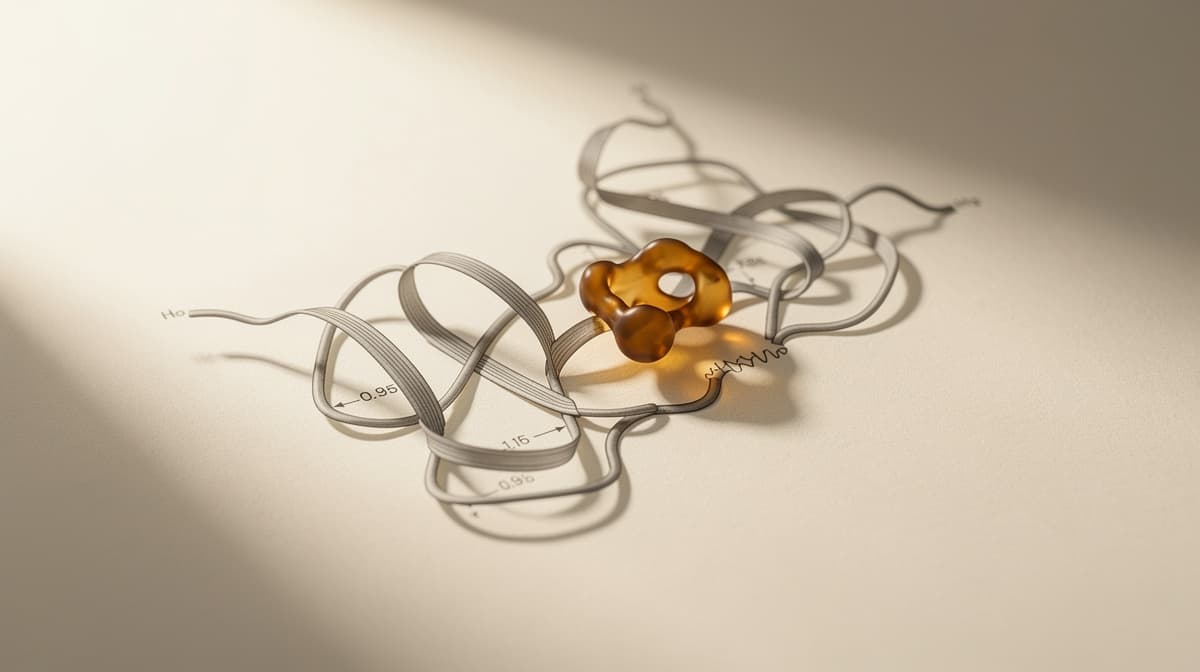
The ipamorelin peptide is the cleanest growth-hormone-releasing peptide (GHRP) in the research catalogue. Where GHRP-2 and GHRP-6 trigger GH release but also elevate cortisol, prolactin, and appetite, the ipamorelin peptide triggers GH release selectively. That's why it's the default GHRP in modern stack protocols.
What the ipamorelin peptide is#
Ipamorelin is a synthetic pentapeptide (five amino acids) that binds to the growth hormone secretagogue receptor (GHS-R, also called the ghrelin receptor). Activating GHS-R triggers growth hormone release from the anterior pituitary, the same pathway the stomach hormone ghrelin uses.
What makes Ipamorelin distinctive among GHRPs is selectivity. Older GHRPs (GHRP-2, GHRP-6, Hexarelin) release GH but also raise ACTH and cortisol, and in humans some raise prolactin and appetite. In the original Raun et al. characterization (1998), done in rats and swine, ipamorelin released GH without raising ACTH or cortisol beyond what GHRH itself produces, even at doses more than 200-fold above those needed for GH release, while GHRP-2 and GHRP-6 raised both.
That selectivity matters. Cortisol elevation counteracts some of the anabolic and recovery effects of GH. Prolactin elevation is undesirable for virtually all use cases. Aggressive appetite stimulation from GHRP-6 can undermine body-composition goals. Ipamorelin avoids all three.
The mechanism in context#
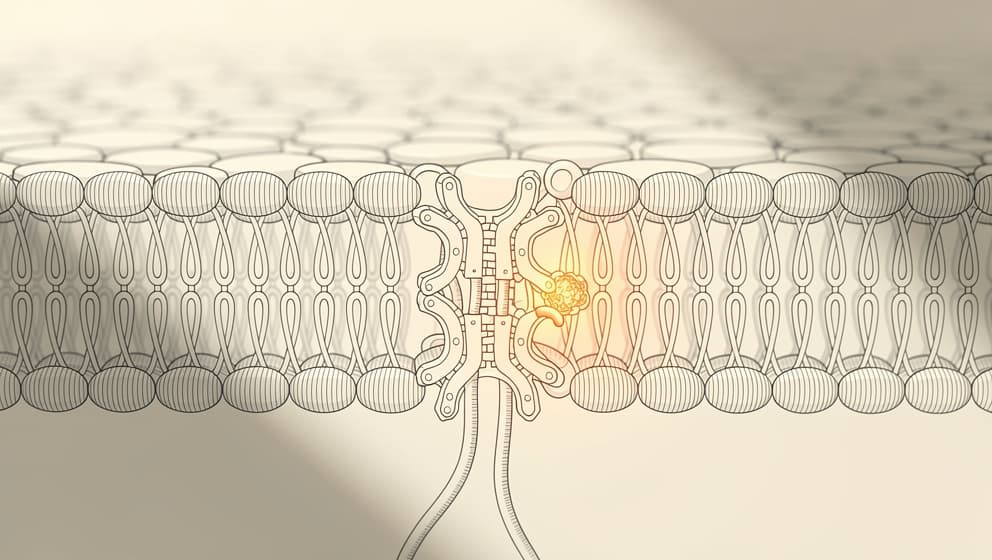
The GH axis has two activation paths:
- GHRH pathway, hypothalamic GHRH activates pituitary GHRH receptors, triggering GH release (CJC-1295, Sermorelin, Tesamorelin act here)
- GHS-R / ghrelin pathway, stomach ghrelin or synthetic GHRPs activate GHS-R, also triggering GH release (Ipamorelin, GHRP-2, GHRP-6, MK-677 act here)
Both pathways converge on the same GH-producing cells. Research suggests activating both simultaneously produces larger GH pulses than either alone. That's why Ipamorelin is typically paired with a GHRH analogue, see CJC-1295 + Ipamorelin stack.
Dosing and administration#

Ipamorelin dosage in the research-use literature has converged on a tight range, with most published protocols using identical anchor points. The ipamorelin dosage framework looks like this:
- Dose: 200 mcg per injection
- Frequency: 1–3× daily
- Route: subcutaneous
- Timing: morning fasted, pre-workout, and/or 30–60 minutes before bed
- Cycle length: 8–12 weeks on, 4 weeks off
Reconstitution math: a 10 mg Ipamorelin vial + 2 mL BAC water = 5,000 mcg/mL. A 200 mcg dose = 4 syringe units on a standard insulin syringe. The peptide calculator handles any vial size.
Single peptide or stacked? Ipamorelin alone produces GH pulses but at lower amplitude than the CJC-1295 + Ipamorelin combination. For protocols that prioritize simplicity or lower-cost entry points, Ipamorelin mono-therapy works. For protocols optimizing for GH-axis effect, stacking is standard.
The ipamorelin benefits reported in the published GH-axis literature, evidence-graded, cluster around a short list. Studies have shown selective GH release with minimal cortisol or prolactin elevation, an endocrine pattern that earned ipamorelin its "cleanest GHRP" reputation. Research suggests downstream IGF-1 elevation that may support recovery, sleep architecture, and lean-mass preservation when paired with adequate training and protein intake. Preliminary evidence in subjective user reporting points to deeper sleep on dosing days, though the controlled-trial base for sleep-quality endpoints is thin. The ipamorelin benefits framing should stay narrower than the marketing literature suggests: cleaner pulse, fewer off-target endocrine effects, and a tolerability profile that holds up across a typical 8-to-12-week cycle. None of those signals carry the weight of a Phase 3 outcomes trial, and Ipamorelin remains unapproved in every major regulatory framework.
Side effects and tolerability#
At typical doses, Ipamorelin's side-effect profile is unusually clean:
- Transient mild hunger, direct ghrelin receptor activation includes some appetite signal, though much less than GHRP-6
- Mild injection-site irritation, common across peptide injections
- Brief light-headed or flushed sensation after dosing (particularly at higher doses)
- Mild transient water retention in the first 1–2 weeks of a cycle
Ipamorelin does not meaningfully elevate:
- Cortisol
- Prolactin
- Aldosterone
- Blood pressure
The side-effect pattern that occurs with GHRP-2 and GHRP-6, aggressive appetite, mood changes, sustained elevated cortisol, is not part of Ipamorelin's profile at research-use doses.
Regulatory status#
Ipamorelin is not approved as a medicine in the US, EU, or Norway. Its one completed efficacy trial, a phase 2 study in postoperative ileus, found no significant difference from placebo (Beck et al. 2014). In the US it is not on the 503A bulks list and sits in Category 2 for 503B outsourcing facilities, so it cannot be lawfully compounded (FDA Category 2 list). WADA prohibits it at all times under class S2. In Norway it is not authorized, and since 15 September 2026 it has been on the Norwegian doping list (Lovdata), which makes acquiring, possessing or using it without lawful authority illegal.
Klarovel does not sell, source, or fulfil peptides. Common research-use formats for Ipamorelin include:
- Ipamorelin standalone: pen (10 mg) and vial (10 mg)
- CJC-1295 + Ipamorelin blend: pen (5 mg + 10 mg) and vial (5 mg + 5 mg)
For most research protocols, the blend is the starting point. Standalone Ipamorelin is useful for protocols that already have a separate GHRH analogue (e.g., Tesamorelin + Ipamorelin rather than CJC + Ipamorelin).
Direct comparisons: Ipamorelin vs CJC-1295, Ipamorelin vs hexarelin, Ipamorelin vs MK-677, Ipamorelin vs sermorelin, Ipamorelin vs tesamorelin.
The practical framework#
Three questions filter the Ipamorelin decision:
- What's the goal? GH-axis effects (sleep, recovery, body composition) → Ipamorelin in combination with a GHRH analogue. Single-mechanism support without stacking complexity → Ipamorelin alone at 200 mcg, 1× daily before bed.
- What's the bloodwork baseline? IGF-1, TSH, fasting glucose, and HbA1c at baseline, repeated at 4–6 weeks. Klarovel's questionnaire builds the schedule.
- What's the stack partner? CJC-1295 (no DAC) is the most-used partner. Tesamorelin is an alternative for protocols that prefer an FDA-approved GHRH analogue backdrop (though Tesamorelin is approved for HIV-associated lipodystrophy, not general GH-axis use).
For the stack protocol, see CJC-1295 + Ipamorelin stack. For the reconstitution mechanics, see the reconstitution guide. For dose math, the peptide calculator handles any vial size.
Ipamorelin is the cleanest way to generate amplified GH pulses without the side-effect noise of older GHRPs. It doesn't do anything anabolic-steroid-dramatic, but it does exactly what it's designed to do: trigger cleaner, more selective GH release. That's the point. To see where the GHRP pathway sits relative to GHRH analogues and oral secretagogues, the GH axis explained maps the full signaling system.
Frequently asked questions
Keep reading
Kisspeptin Peptide: What Human Trials Show About HPG Axis
Kisspeptin peptide switches on the brain's reproductive axis. See what human trials actually show about LH timing, testosterone, and dosing limits.
LL-37 Peptide: Evidence, Risks, and Unanswered Questions
LL-37 peptide kills bacteria by rupturing membranes, but human evidence stops at topical ulcer trials and one gene-therapy study, not injections.
Wegovy Pill: How It Works, How to Take It, and Results
The Wegovy pill is semaglutide 25 mg taken daily, FDA-approved for weight loss in December 2025. How to take it, how well it works, and how it compares.