
Most articles about buying peptides in Norway are written by people selling them. This one is not. Norway operates one of the strictest personal-import regimes in Europe, and since 15 September 2026 seven of the most widely discussed research peptides have been on the criminal doping list. Understanding that framework before ordering anything is the difference between a compliance question and a police matter.
Key takeaways#
-
Private individuals in Norway may not import medicinal products by post at all. Tolletaten states that private import of medicinal products in consignments is not permitted, for both prescription and non-prescription items, and such consignments can be stopped in customs control.
-
A product's status in the sending country is irrelevant. A product can be classified as a medicinal product in Norway even when it is not classified that way in the country it is imported from.
-
Since 15 September 2026, BPC-157, CJC-1295, ibutamoren, ipamorelin, TB-500, tesamorelin and sermorelin are on Norway's statutory doping list, after a DMP consultation in June 2026.
-
Seizure is procedural, not discretionary. Recipients get a written notice and 10 days from the notice to respond with justification that the item is legal to import.
-
Black-market analysis is not theoretical. Official control laboratories have identified modified growth hormone and glycine-extended GHRP analogues circulating in seized product.
Norway's import rules make buying peptides a customs question, not a shipping question#
The starting point is not the peptide. It is the classification. DMP (Direktoratet for medisinske produkter) administers the doping list under the doping regulation , and it also maintains the medicinal-product classification lists that determine whether a substance crossing the border counts as a legemiddel.
The import rule itself is blunt. Postal consignments containing medicinal products from abroad, both prescription and non-prescription, are not permitted and can be stopped in customs control; the stated purpose of the strict framework is to limit incorrect use and protect consumers against falsified and illegal products. There is a narrow EEA carve-out written into the regulation for non-prescription products, but it is functionally closed: private individuals may only import non-prescription medicinal products approved in Norway, with Norwegian package text, from EEA countries, which in practice means very few or no products qualify.
Two consequences follow, and they trip up almost every first-time buyer. First, holding a prescription from a Norwegian doctor does not confer the right to buy a corresponding product from abroad. Second, the third-country route is closed outright. Import by consignment from third countries is not permitted, and import by consignment of prescription-only products is not permitted. That covers the overwhelming majority of vendors marketing to Norwegian buyers.
Most of the popular research peptides now sit inside Norway's doping-law perimeter#
This is the part that changed recently, and it changes the risk profile materially.
Norway runs two parallel lists. The sports list is WADA's. The criminal list is domestic. The criminal doping list covers fewer substances than the sports list because the listing criteria differ. Historically that gap was where GH-axis peptides lived: prohibited in competition, but not named in the criminal regulation.
That gap has now closed for seven of them. In a consultation document dated 9 June 2026, DMP proposed adding BPC-157, CJC-1295, ibutamoren, ipamorelin, TB-500, tesamorelin and sermorelin to the doping list with their chemical names and CAS numbers, and the amending regulation FOR-2026-09-14-1794 added all seven, in force from 15 September 2026. The regulator's own reasoning is candid about the evidence base: it notes that the lack of human research means little is known about the substance's safety profile for BPC-157.
The legal weight of a doping-list entry is not administrative. Manufacture, import, export, storage, sending and transfer of substances covered by the doping regulation can be criminal under the Penal Code sections 234 and 235, and acquisition, possession and use without lawful access are prohibited under the Medicines Act section 24a.
Use, possession and acquisition of doping agents have been prohibited in Norway since 1 July 2013. Acquisition, possession and use are punishable by fines or up to six months' imprisonment under the Medicines Act section 31, while unlawful import, storage, sending or transfer carries up to two years under Penal Code section 234, and up to six years in aggravated cases under section 235.
The list is amended by regulation, so anyone assessing their position should check the current consolidated text of forskrift 30. april 1993 nr. 318 on Lovdata rather than relying on a blog post, this one included.
"Research use only" is a labelling convention, not a legal shield#
The phrase appears on nearly every vial sold online. It has no standing at the Norwegian border. Customs classifies by substance, not by the sticker.
The international regulatory picture reinforces this. In the United States, the FDA placed BPC-157 in Category 2 of the interim 503A bulk substances list on 29 September 2023, citing risk of immunogenicity for certain routes of administration, complexities regarding peptide-related impurities and active ingredient characterisation, and no or only limited safety-related information for the proposed routes of administration. That is a regulator saying the manufacturing and identity questions are unresolved, not that the compound is uninteresting. BPC-157 left Category 2 in April 2026 after its nomination was withdrawn, and an FDA advisory committee voted in July 2026 to recommend it for the 503A bulks list, but no rule has followed, and FDA states that leaving Category 2 does not by itself authorize compounding (see the FDA Category 2 list). None of that changes its status in Norway.
On the sports side the position is settled. WADA's prohibited list covers GHRH and its analogues including CJC-1295, sermorelin and tesamorelin, growth hormone secretagogues including ibutamoren and ipamorelin, the GHRP family, and thymosin-beta-4 derivatives such as TB-500 . Anyone competing under an anti-doping code, at any level, should treat that list as binding regardless of what Norwegian criminal law says on a given date.
Tolletaten runs a fixed seizure procedure, and buyers usually lose the parcel#
When a consignment is stopped, the sequence is standardised.
The recipient receives a notice that the contents have been withheld. The seized items are held by the postal or courier company until it is clarified whether the import was lawful. Under § 3-2a of the import regulation, the importer can respond within 10 days of the notice being sent. If no reply arrives within the deadline, the medicine can be seized and destroyed; if the importer does reply, DMP decides whether it is released or destroyed. Any other lawful contents of the parcel are released.
Escalation beyond destruction is discretionary but real. Reporting to the police is possible depending on severity, under the Medicines Act or under the penal provisions covering narcotics or doping agents.
One practical detail is worth flagging for people who assume supplements are a workaround. Several products sold as food supplements in other countries are classified as medicinal products in Norway, for example high-dose vitamins, and such products can be seized and destroyed.
Vitamins and minerals for personal use taken orally are generally not stopped, but private import of vitamins intended for injection is not permitted. The injectable format itself is a classification trigger.
Seized products show what an unregulated supply chain actually contains#
Assume for a moment the legal question is resolved through a legitimate prescriber route. The product question remains, and it is not academic.
Official control laboratories have documented what actually circulates. A study analysing seized growth-promoting black-market products identified a modified growth hormone of 192 amino acids carrying an additional N-terminal alanine, plus three glycine-extended GHRP analogues: Gly-GHRP-6, Gly-GHRP-2 and Gly-Ipamorelin, with structures characterised by high-resolution tandem mass spectrometry. These are not degraded batches. They are different molecules sold under familiar names.
A separate screening programme run for Belgian medicines authorities makes the scale clear. The team developed an LC-MS/MS method specifically for seized injectable peptide preparations, noting that counterfeit and illegal protein and peptide substances could imply severe health threats as demonstrated by numerous case reports, and that the Belgian agency and customs work with global counterparts to curtail trafficking and distribution.
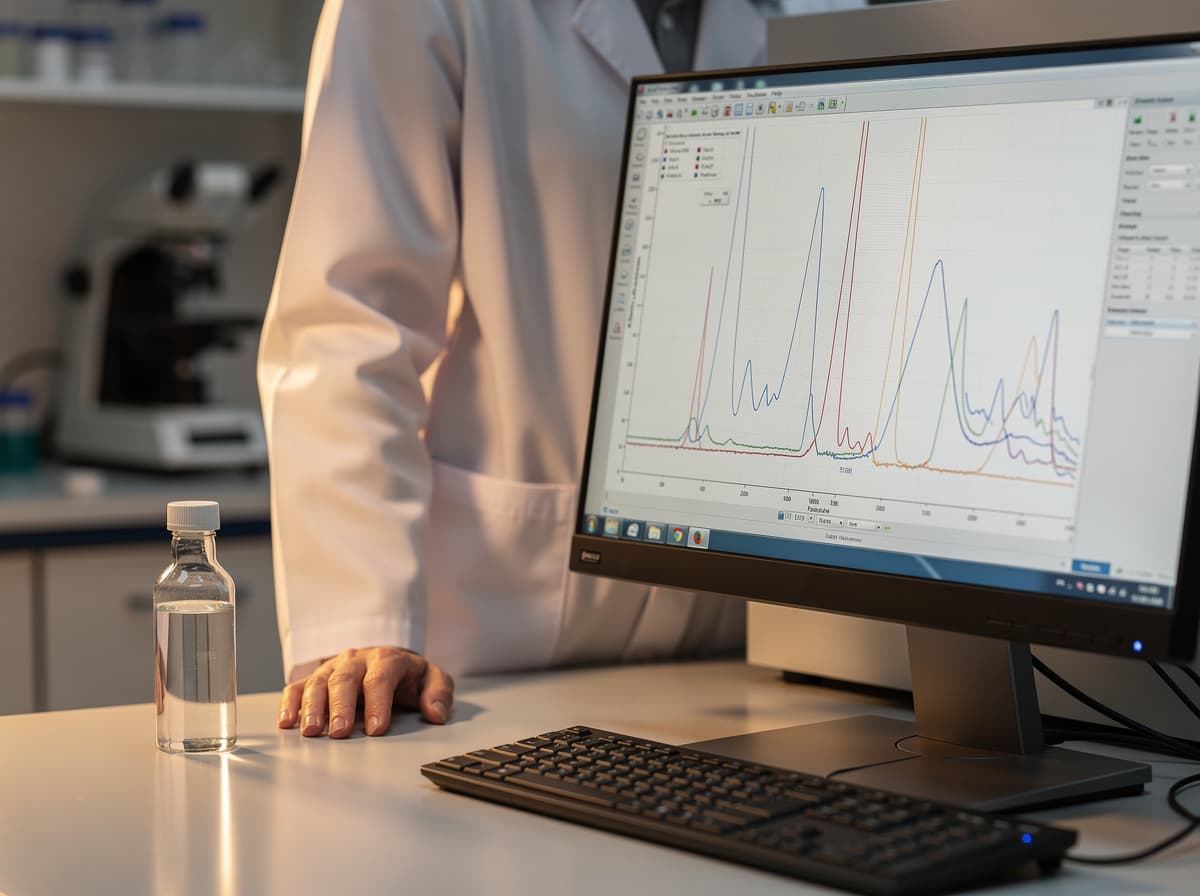
The analytical lesson generalises. Chromatographic purity and molecular identity are two different questions, and only the second one catches substitution. Research suggests that a certificate showing a clean single peak says nothing about whether the peak is the ordered sequence. Mass spectrometry, not HPLC alone, is what control laboratories use to confirm identity. None of this makes an unauthorised import lawful in Norway; it is the reason the law treats unverified supply as a health risk.
If you are working through reconstitution and concentration maths for a clinician-supervised protocol, the peptide calculator removes the arithmetic errors that compound every other uncertainty in the chain.
A compliant path exists, and it runs through a prescriber rather than a vendor#
Norway does have a legal mechanism for unapproved products. It is narrow and it is clinician-led.
If a doctor considers that a patient needs a product not approved in Norway, the doctor can apply for a godkjenningsfritak (exemption from marketing authorisation), and the product is then imported specifically for that patient via a wholesaler or pharmacy in Norway.
DMP normally does not grant import permission to private individuals where the justification is simply that the product is unavailable in Norway.
The realistic sequence for a Norwegian resident is therefore: clinical assessment first, exemption application by the prescriber second, pharmacy-channel supply third. Direct-to-consumer ordering does not appear anywhere in that sequence.
This is also where Klarovel's model matters. Klarovel sells nothing: no peptides, no fulfilment, no supplier referrals. Revenue comes from protocol purchases, and what a purchase buys is protocol guidance and education. That is set out in our disclosures and explained end to end in how it works.
Preliminary evidence on several of these compounds is genuinely interesting, and preclinical data points toward mechanisms worth following. That is not the same as a settled human safety profile, and it does not change what Norwegian law allows.
The compliance layer is the protocol layer#
Peptide research is moving faster than peptide regulation, and Norway has responded by tightening rather than loosening. That is the operating environment. Anyone who tells you otherwise is either uninformed or selling something.
The disciplined position is straightforward: know the classification first, work through a licensed clinician, and treat unverified supply as unverified regardless of what the label promises. Peptides may support specific research and wellness objectives, and the current evidence base is associated with real mechanistic findings, but none of that survives contact with a seized parcel or a criminal referral.
Klarovel exists to make that layer legible. Create a free account to access the protocol library and jurisdiction notes, and read how it works to see what the engine does and does not do.
Frequently asked questions
Keep reading

Wegovy Side Effects: How Common, How Long, How Serious
What the Wegovy label and pooled STEP data actually report: incidence per side effect, median duration in days, and the one that does not fade.

Peptide Drug Interactions: What Research Actually Shows
Peptide drug interactions remain understudied. Here is what current research suggests about GLP-1 agonists, GH secretagogues, and repair peptides.

Peptide Bloodwork Panel: The Baseline Labs That Matter
A research-grade guide to peptide bloodwork panels: which markers to draw, when to retest, and how to read IGF-1, lipase, and metabolic shifts safely.